





On August 23, the Unicamp Open Doors 2025 (UPA) event promoted another memorable encounter between science and society. Around 45,000 visitors circulated through the campus of the University of Campinas (Unicamp), and among them, more than 1,500 attended the activity “CancerThera: new perspectives in cancer diagnosis and treatment,” which occupied a space specially prepared both to explain how cutting-edge research in the production of radiopharmaceuticals is carried out at the institution and to promote dialogue between scientists and young students, their families, and teachers.
The participation of CEPID CancerThera in the 20th edition of UPA went far beyond the presentation of posters, models, and interactive experiments. Above all, it was an exercise in listening and inspiration. Visitors were able to speak directly with researchers, ask questions, dispel fears, and discover that radiation, often seen as a threat, can also be a powerful ally to health.
“We know that a research field involving radiation, like ours, raises many questions from society. So, participating in UPA is a way to talk about the subject in order to reduce fear and prejudice,” explains Dr. Carmino Antonio de Souza, onco-hematologist physician, professor at the School of Medical Sciences (FCM) at Unicamp, and principal investigator of CancerThera.
Another topic in the conversations between scientists and visitors during UPA was cancer itself, a condition that affects the health of countless people directly or indirectly, and whose associated suffering can be intensified by misinformation—especially false or inaccurate content circulating on the internet about the topic—thus increasing fear and stigma.
Being present at UPA “is a way for the CancerThera team to dispel prejudice and help people understand that cancer is a group of diseases with which we will live, but that science has developed many important advances to face it,” highlights Souza.
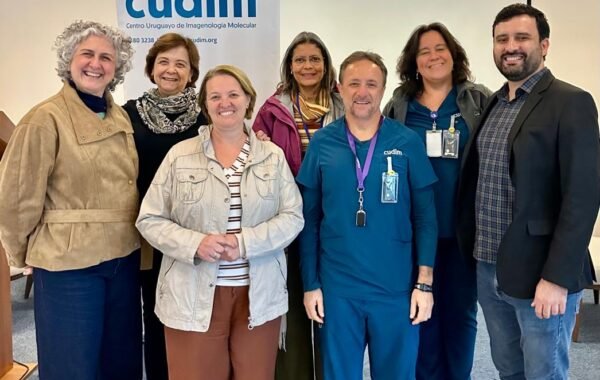
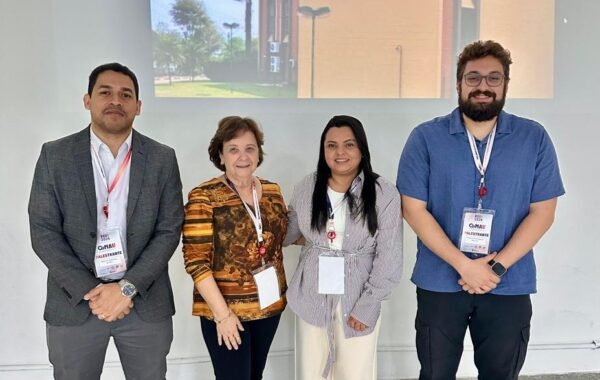
PHOTO GALLERY | CEPID CancerThera at Unicamp Open Doors 2025

Knowledge is fascinating

From Campinas (SP), translator Elizângela Rúbia Ramos Pinto Pinto, who brought her daughter interested in studying Medicine to learn about the campus and its many possibilities, highlighted the impact of the experience: “I found it fascinating.” She explains that her enchantment was due to the multidisciplinary nature of the CancerThera team (composed of chemists, physicists, biologists, physicians, among other professionals) and how different fields come together for the benefit of oncology patients. She also states that, after the visit, she felt hopeful and proud to know that such innovative research is taking place near her, in her city.
For teacher Antonia Edna Takamine, from Bragança Paulista (SP), accompanied by her daughter and 30 students, the visit was transformative: “It is a high-technology subject, but explained in an accessible, very easy-to-understand way.” She, who already discussed radiopharmaceuticals in the classroom with her elementary and high school students, now has even more elements to support her in addressing misinformation about the use of radiation. “It is necessary to be informed. Once you have knowledge about radiation, you realize that it is very important, for example, for diagnosis and treatment in the field of Health,” she says.
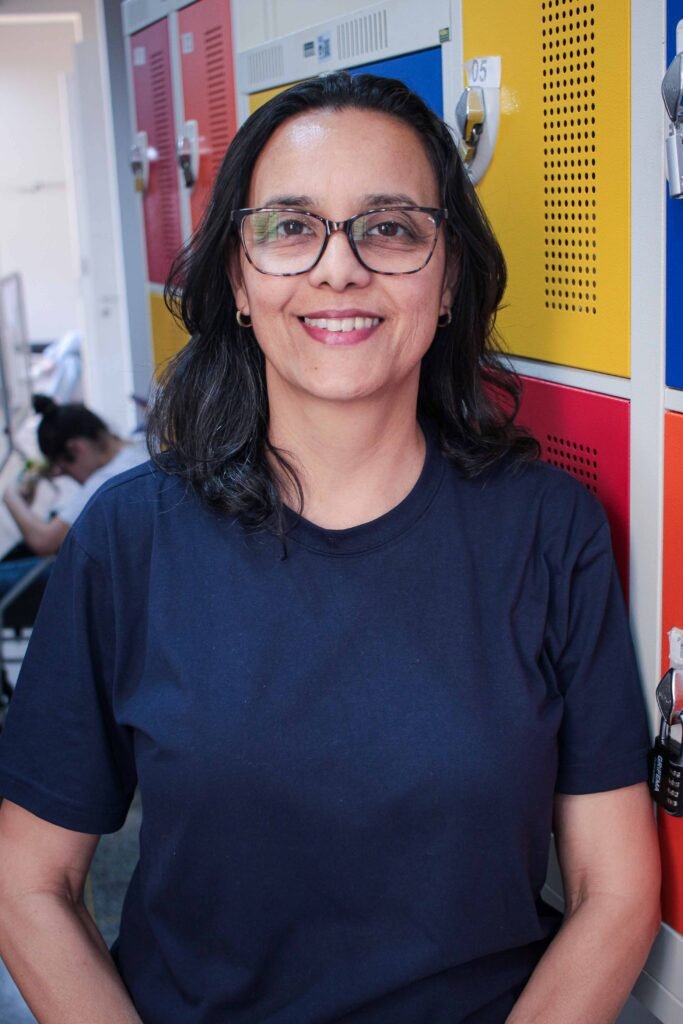

Chemist Patrícia Vasconcelos Barbosa, from Campinas (SP), who brought her two daughters and one of their friends to visit the university, summarized the feeling in a single word: “hope.” A former researcher and now working in industry, she was moved to tears seeing and hearing up close the purpose of the CancerThera scientists. With a trembling voice, she reports: “I was emotional because I think it is beautiful, in the field of research, to see people dedicating precious time to trying to find new paths that can impact other people’s lives. These studies can make the experience of people with cancer different, with another quality, different from the discomfort and suffering caused by the disease.”
The satisfaction of being part of UPA resonates not only among those who pass through the exhibition and interactive space set up in the Arenas of FCM/Unicamp, but also among members of the organization and mediation team of the CancerThera activity, which this year included 40 people.
“The great stimulus of UPA is to generate the scientists of tomorrow. So, bringing them to these environments encourages future choices to become clearer, more enjoyable, and more definitive. It is very nice that children and adolescents come accompanied by their parents, grandparents, and teachers, so that they themselves are also encouraged and can continue to encourage these scientists of tomorrow in their daily lives,” says Souza, who has been an enthusiast of UPA since its first editions.
The visitor journey in the CancerThera activity
Organized into groups of 40 people, visitors entered the anteroom of the CancerThera exhibition space to watch an introductory video about the research center and its main scientific activities. They were then guided to the hall of the FCM/Unicamp Arenas, where four different teams explained how cancer and radiopharmaceuticals work, as well as demonstrated how investigations take place in a translational manner across the three research axes of CancerThera: Basic, Preclinical, and Clinical.
At the CancerThera Arena, the public learned about the concept of “Theranostics,” which combines diagnosis and treatment into a single approach. A model showed how molecules linked to radioisotopes connect to target cells to locate and treat tumors. Posters illustrated how PET/CT scans work and other applications of nuclear technology, such as metabolism and body composition analysis, which are essential for personalizing therapies.
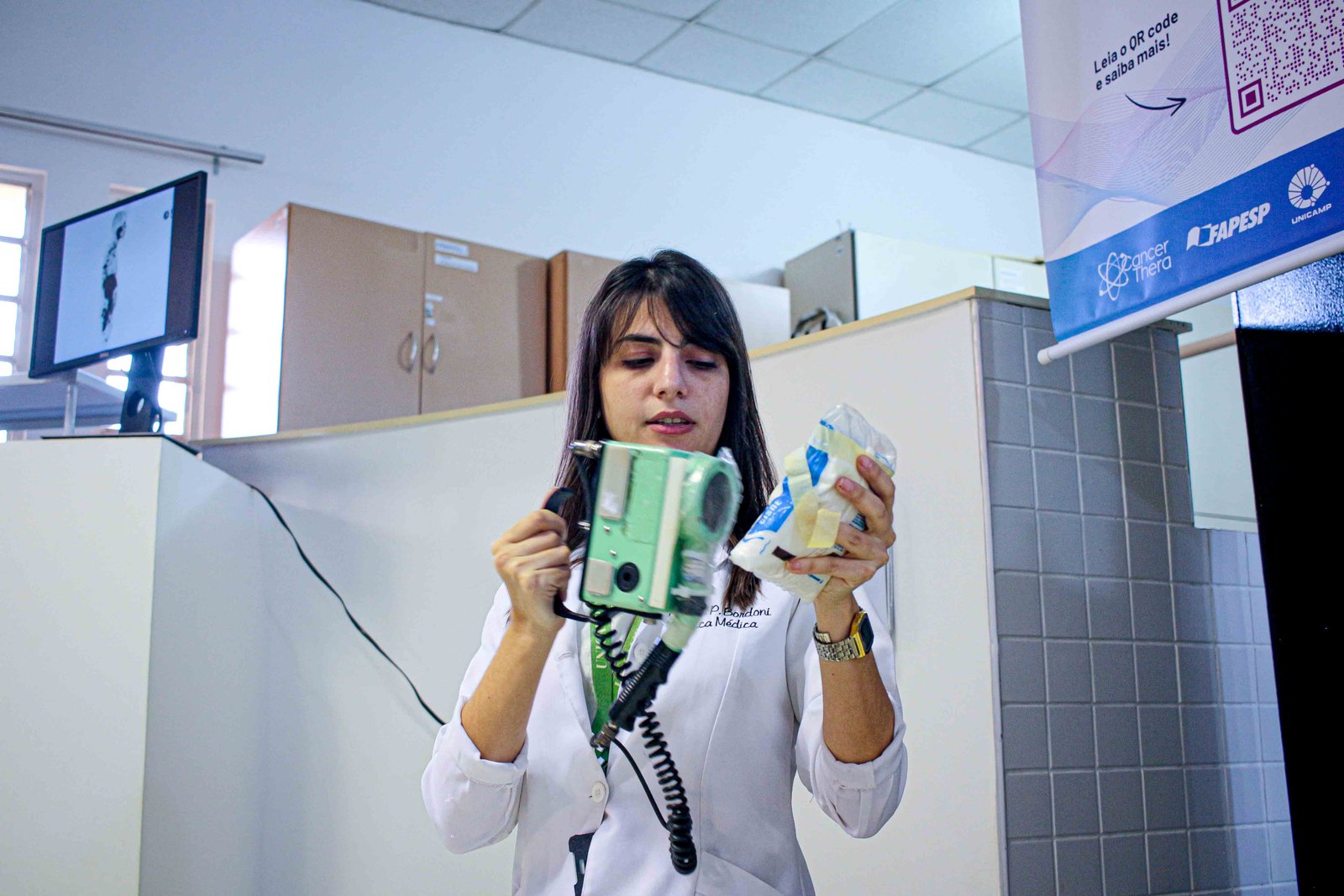
In the Basic Research Arena, visitors were able to understand what radiation is and how it is present in everyday life, with examples such as table salt and monazite sands. A torso mannequin and Geiger-Müller detectors allowed visitors to see in practice how radiation is safely used to diagnose diseases, accompanied by videos showing PET/CT scans in action.
The Preclinical Research Arena team addressed how new molecules against cancer are developed and tested. The public learned about compounds evaluated in tumor cells and animal models, as well as drugs for topical use in the treatment of skin cancer. Chemical models, colored solutions, and illustrative posters complemented the experience.
Finally, in the Clinical Research Arena, the sentinel lymph node procedure was simulated, used to detect the spread of cancer throughout the patient’s body. A mannequin with an oral lesion and cervical metastasis, marked with radiopharmaceuticals, allowed the activity presenters to use a probe device to locate affected areas, reproducing a real Nuclear Medicine procedure.
Throughout the day, each arena became a dynamic space for learning and exchange, where visitors could see science being shared and researchers had the opportunity to renew the meaning of their mission. More than explaining techniques, CancerThera showed that science is encounter, dialogue, and also hope.
Souza summarizes the importance of the initiative and each member’s willingness to contribute: “Participation in UPA is an opportunity for several members of our research center—our students from undergraduate research to postdoctoral level, together with principal and associate investigators—to show, in a very simple, playful, and objective way, what we do.”
Text: Romulo Santana Osthues | Photos: Romulo Santana Osthues, Carmen Silvia Passos Lima e Maria Carolina Santos Mendes