




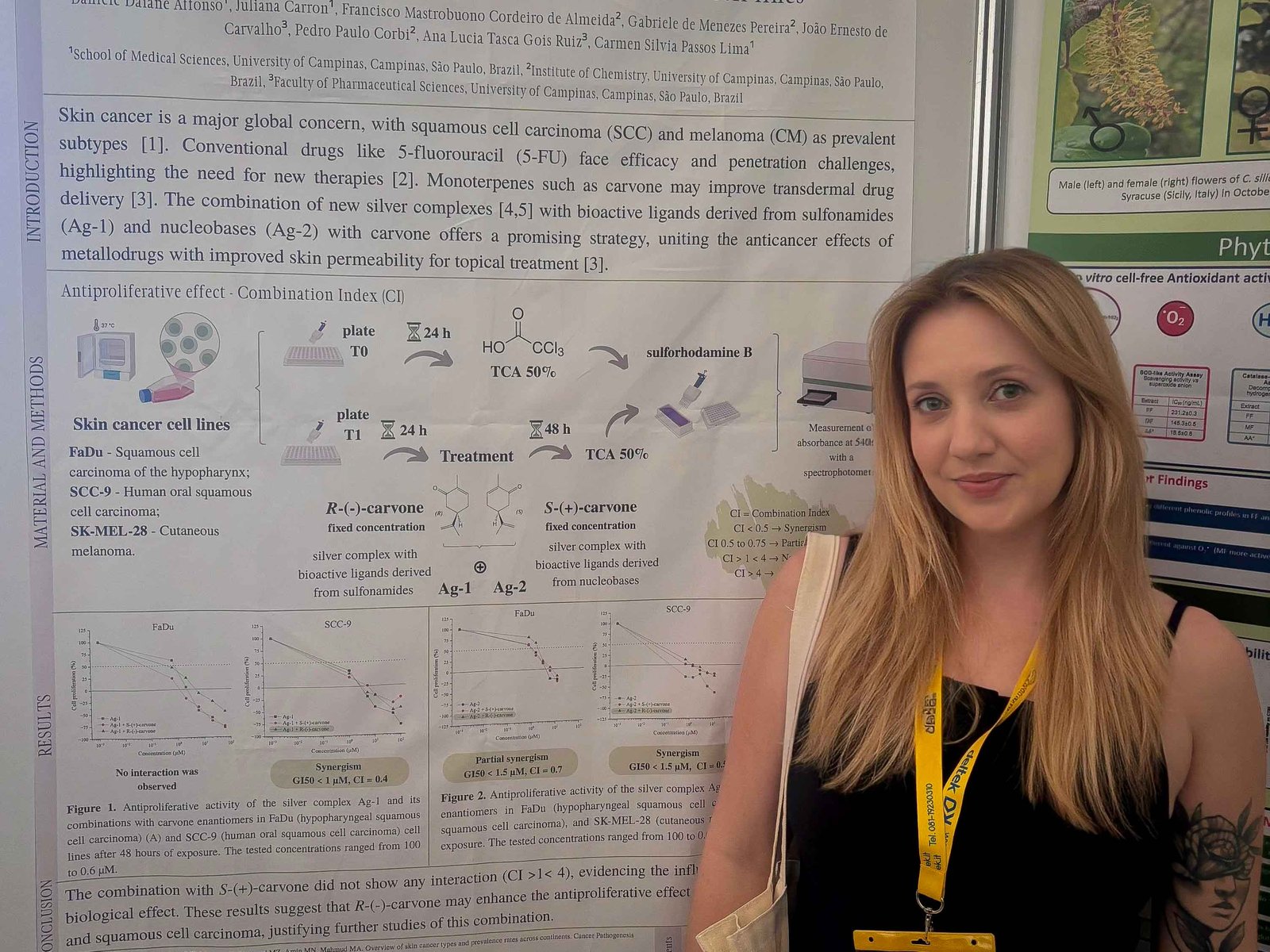

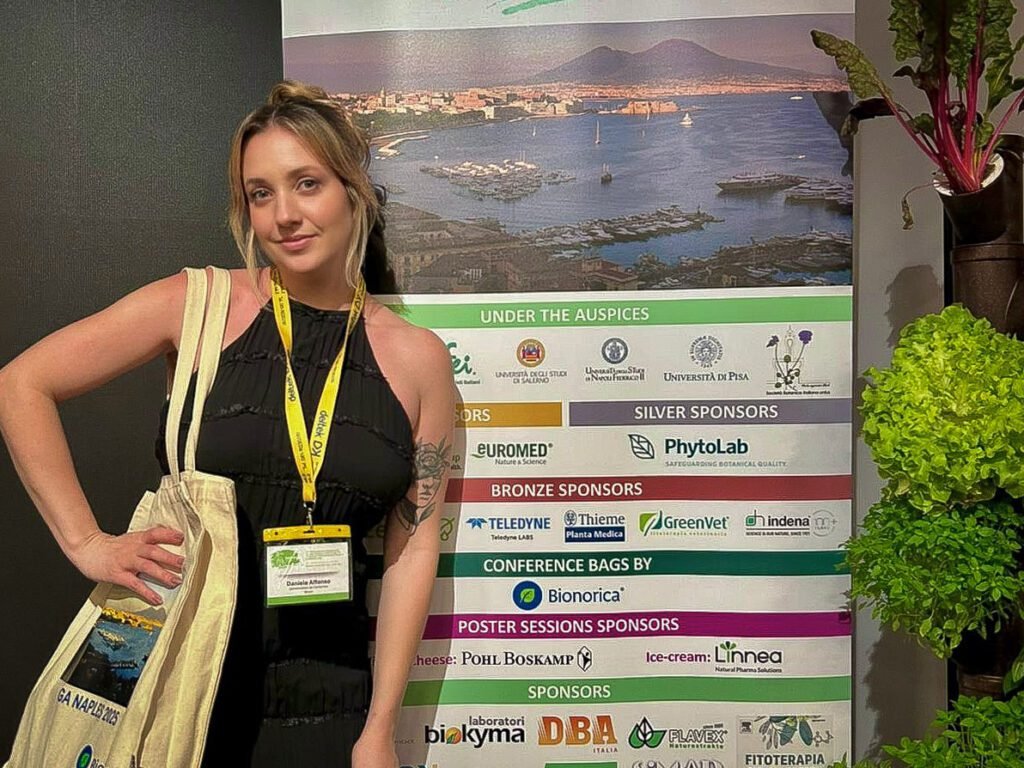
Ma. Daniele Affonso, a biologist and PhD candidate affiliated with CEPID CancerThera and working at the Cancer Genetics Laboratory (Lageca) of the University of Campinas (Unicamp), participated in the 73rd International Congress and Annual Meeting of the Society for Medicinal Plant and Natural Product Research, held in partnership with the Italian Society of Phytochemistry, between August 31 and September 3, 2025, in Naples, Italy. The event brought together scientists from around the world to discuss the most recent advances in the field of natural products and their therapeutic potential.
Affonso presented the work Evaluation of the antiproliferative effect of enantiomers of carvone in association with silver complexes in skin cancer cell lines, which investigates the potential of carvone – a monoterpene present in essential oils – in association with silver metal complexes for the treatment of skin cancer.
Monoterpenes are natural molecules present in essential oils from plants such as mint, lavender, and citrus fruits. They are responsible for many of the aromas and flavors we perceive and, in addition, have important biological properties, such as anti-inflammatory, antimicrobial action, and even anticancer potential.
The uniqueness of the research and next steps
Interest in the molecule arose during the researcher’s master’s studies, when she investigated the essential oil of Mentha aquatica (water mint), rich in carvone (with a concentration of around 62%), conducted at the Laboratory of Phytochemistry, Pharmacology and Experimental Toxicology (LAFTex) at Unicamp.
“During my PhD, this experience was combined with the study of silver complexes, which had already shown strong antiproliferative activity. The idea of associating carvone arose both from the pharmacological potential observed in cell culture tests and from its property of facilitating the cutaneous permeation of drugs, enhancing the efficacy of metal complexes,” explains Affonso, who is currently supervised by Dr. Carmen Silvia Passos Lima, an oncologist and hematologist, professor at the School of Medical Sciences (FCM) at Unicamp, principal investigator at CancerThera, and coordinator of Lageca.
One of the central aspects of the study is the analysis of the enantiomers of carvone, “mirror” molecular forms known as R and S. Enantiomers have the same chemical formula and the same atoms, but arranged differently in space. It is similar to our hands: the right and the left have the same structure but do not perfectly overlap. According to Affonso, “this structural difference, apparently subtle, can cause each enantiomer to interact differently with biological targets, resulting in distinct pharmacological properties.”
The results showed that the combination of silver complexes with R-(−)-carvone enhanced antiproliferative effects in different skin cancer cell lines, reinforcing previous findings by the researcher, who had already observed greater cytotoxicity of this enantiomer in three-dimensional keratinocyte models.
The next challenge is to advance to experimental models closer to biological reality. The researcher explains that it will be necessary to move to 3D tumor spheroid models (which are mini-tumors grown in the laboratory), evaluate molecular mechanisms such as induction of apoptosis (natural and programmed cell death) and alterations in the cell cycle, in addition to conducting skin permeation tests. If the results are confirmed, the research will proceed to stages in animal models, evaluating toxicity and efficacy, before considering future clinical trials.
In addition to Affonso and Lima, the study authors – all affiliated with CancerThera – are: Juliana Carron (FCM/Unicamp); Francisco Mastrobuono Cordeiro de Almeida, Gabriele de Menezes Pereira and Pedro Paulo Corbi (Institute of Chemistry at Unicamp); and João Ernesto de Carvalho and Ana Lucia Tasca Gois Ruiz (School of Pharmaceutical Sciences at Unicamp – FCF).
Encouragement to pursue an academic career
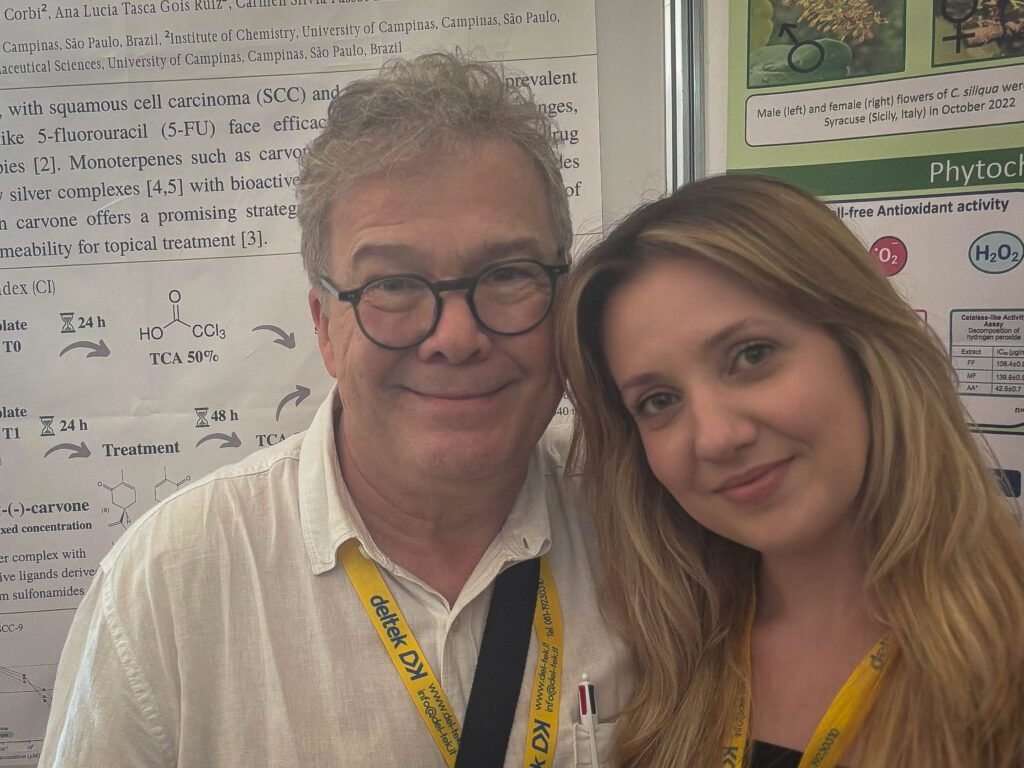
Beyond the scientific relevance of presenting preliminary results from her research, participation in the congress was a milestone in her personal and professional trajectory. “I consider it fundamental for a research career and for the visibility of CancerThera abroad. In addition, the contact established with foreign researchers will certainly facilitate the establishment of partnerships between universities,” says her supervisor.
“In addition to improving my scientific communication in English, I was able to establish contacts with researchers from other universities, which may lead to future collaborations, especially in areas such as formulations and transdermal patches,” highlights Affonso, whose PhD scholarship and research funding are provided by the São Paulo Research Foundation. She adds: “This experience further strengthened my motivation to pursue an academic career and internationalize my research.”
Text: Romulo Santana Osthues | Photos: Personal archive of the researcher