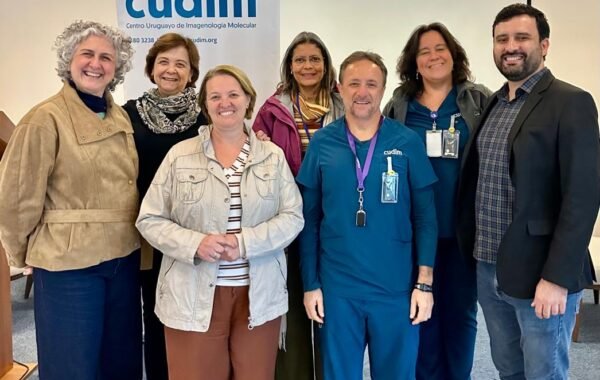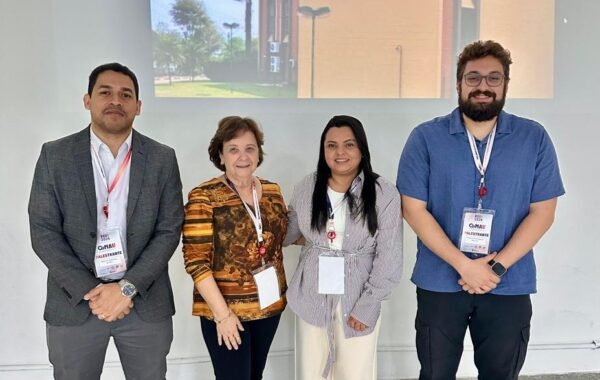





Between October 29 and November 1, researchers from CEPID CancerThera had the opportunity to present their investigations in the development of radiopharmaceuticals for use in the context of cancer and to engage in dialogue with a specialized audience about advances in Onco-hematology during the Brazilian Congress of Hematology, Hemotherapy and Cellular Therapy (HEMO 2025).
Held at the Transamérica Expo Center, in São Paulo (SP), and organized by the Brazilian Association of Hematology, Hemotherapy and Cellular Therapy (ABHH), the event is considered the largest in the field in Latin America, bringing together, this year, around 8,000 participants, including physicians, researchers, residents, multidisciplinary professionals, managers, and representatives of the pharmaceutical and equipment industries.
CancerThera – Center for Theranostic Innovation in Cancer – is supported by the São Paulo Research Foundation (FAPESP) as a Research, Innovation and Dissemination Center (CEPID) since May 2023, when it began its activities. The following institutions are part of CEPID CancerThera in its operation: the Hematology and Hemotherapy Center of the University of Campinas (Hemocentro/Unicamp); the Faculty of Medical Sciences of Santa Casa de São Paulo (FCMSCSP); and the Institute of Chemistry of São Carlos of the University of São Paulo (IQSC/USP).

An unprecedented way of being present at a scientific event

It was the first time that CancerThera participated in a scientific event with an exhibition booth dedicated to the dissemination of its activities. In addition, “it was the first year in which we brought information, from clinical and scientific as well as epidemiological perspectives, about hematological diseases and tumors to our congress. This was auspicious, it was very important and, truly, I am very pleased to open this possibility,” says Dr. Camino Antonio de Souza, onco-hematologist, professor at the Faculty of Medical Sciences of Unicamp and principal investigator of CancerThera.
For Souza, who is also a member of the Scientific Committee of Onco-hematology of HEMO 2025, the moment symbolizes a new stage of integration between CancerThera and ABHH, which have been partner institutions since the beginning of the center’s activities: “We have more than 100 exhibitors and, this year, we can say that our CEPID CancerThera is one of them.” The exhibition fair, held in parallel with the scientific activities, brought together representatives of the latest innovations in therapies, medications, equipment, and technological solutions.
“It was a new moment, which we will probably repeat every year from now on, and which showed that we are beginning to reintegrate ourselves into this world of Onco-hematology within our research center – a field still to be widely explored. We have much to learn,” he adds.

Dr. Maria Elvira Pizzigatti Corrêa, dentist and postdoctoral researcher in Research Management – Executive Management at CancerThera, highlighted the relevance of the center being present at a congress focused on Hematology. According to her, participation reinforces the link between the hematological field and the research lines of the center, especially those related to the development of radiopharmaceuticals aimed at hematological tumors, which are currently under investigation.
“Being at HEMO 2025 is strategic for us because Hemocentro/Unicamp is the host institution of CEPID CancerThera. Our research involves hematological diseases, such as, for example, studies on new radiopharmaceuticals for multiple myeloma and myelofibrosis. In addition, our project is multidisciplinary, and through translational research we create a scientific union among the various areas of knowledge that compose it, in search of new therapies for cancer patients,” she evaluates.
The event featured a program distributed across 10 simultaneous thematic rooms, covering areas such as Onco-hematology, Cellular Therapy and Bone Marrow Transplantation, Hemostasis and Thrombosis, Flow Cytometry, Pediatric Hematology, and Palliative Care. In addition to scientific sessions, HEMO 2025 included corporate symposia, discussion forums, academic league meetings, and the Hemo Play Podcast studio, which recorded live interviews and debates during the congress.
A space for building scientific networks
Installed in the Collaborative Square of the exhibition fair, the CancerThera booth became a meeting point for visitors interested in learning about the center’s research lines, which operates at the interface between areas such as Radiochemistry, Radiopharmacy, Medical Physics, Oncology, Hematology, and Nuclear Medicine. In an environment that brings together the main specialists in the country in the fields within the scope of HEMO 2025, the center’s booth represented not only a space for scientific dissemination, but also for building bridges between society and basic, pre-clinical, and clinical research.
Researchers from different groups that make up CancerThera were present to talk to the public, present informational materials, and highlight the advances of ongoing investigations aimed at innovation in radiopharmaceuticals for application in the theranostic model – which integrates diagnosis and therapy in sequential procedures in the care of cancer patients.

One of the researchers present was Dr. Luciana Malavolta Quaglio, who is a radiochemist, professor at FCMSCSP, and principal investigator at CancerThera. She emphasized the relevance of the interaction provided by the congress, both with other researchers and with students and professionals in training. The CancerThera booth, in her opinion, was a valuable space to present what we are developing and to discuss new therapeutic perspectives in cancer.
Quaglio also highlighted the innovative nature of the event and the opportunity to communicate science in an accessible way: “I think it is essential to disseminate our work, not only at this congress, but at others in the oncology field. This communication with this specific target audience, among students and fellow researchers, is sensational, offering a great opportunity for learning and exchange.”
Scientific dissemination: institutional commitment

For Gilberto Carlos Franchi Júnior, pharmacist and associated researcher at CancerThera, the presence of the center at HEMO 2025 reflects a commitment to scientific dissemination and multidisciplinary interaction: “For me, it is always a privilege to be in contact with researchers, physicians, nurses, pharmacists, and biologists, all dedicated to Hematology and Oncology. It is gratifying to be here representing CancerThera.”
He also reinforced the importance of communicating scientific knowledge to society. “Disseminating science is an obligation of researchers. Speaking the language of those who actually fund all this science that the country so greatly needs and uses daily is essential. It is a privilege to see institutions like FAPESP and CancerThera promoting this interaction within the event with a wonderful booth,” he says.

Dr. Romulo Santana Osthues, scientific journalist and postdoctoral researcher in Research Management – Education and Knowledge Dissemination, emphasized the importance of CancerThera researchers participating in scientific and extension events aimed at diverse audiences, expanding the reach of scientific communication.
According to Osthues, “participating in congresses such as HEMO allows researchers to reflect on different ways of communicating the science they produce.” And he adds: “Carrying out scientific dissemination oriented to the target audience, in a dedicated way, is essential for reaching a greater diversity of interlocutors and for making scientific knowledge more accessible and relevant to different segments of society.”
Text: Romulo Santana Osthues | Photos: Romulo Santana Osthues com with collaboration from Maria Elvira Pizzigatti Corrêa and Gardênia Barbosa.