




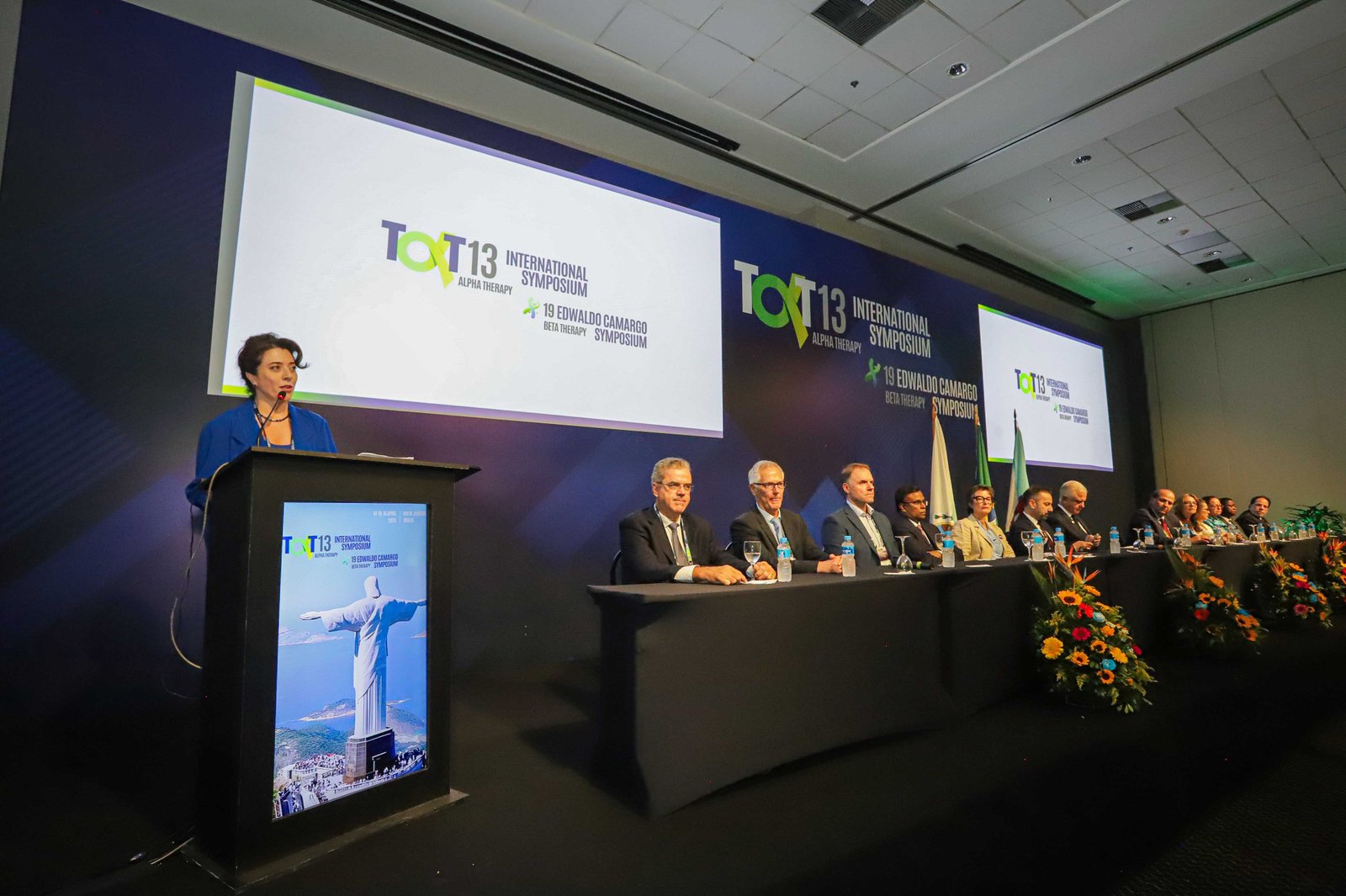

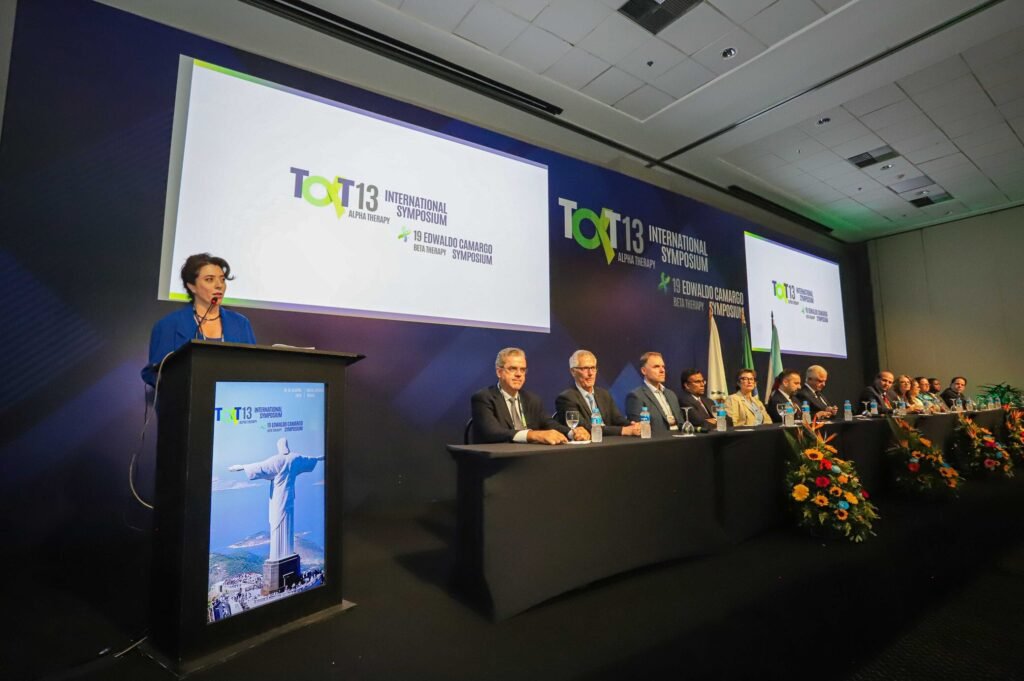
Between April 14 and 16, the Windsor Barra Convention Center, in Rio de Janeiro (RJ), hosted an important meeting for global Nuclear Medicine. The joint realization of the 13th International Alpha Therapy Symposium (TAT 13) and the 19th Edwaldo Camargo Symposium – Beta Therapy brought together specialists from around the world to discuss innovations and clinical practices in the field.
CEPID CancerThera marked its presence with outstanding performance on several fronts, engaging in organization, fostering partnerships through its own booth, and presenting and evaluating scientific works. The event was promoted by: Brazilian Society of Nuclear Medicine and Molecular Imaging (SBMN), European Commission, Edwaldo Camargo Teaching and Research Institute (IEPEC), Nuclear Medicine Group – Diagnosis and Therapy (MND Group), and Nuclear Medicine Research Infrastructure (NuMeRI).

Patient-focused purpose and global connections
Dr. Elba Etchebehere, nuclear physician, professor at the Faculty of Medical Sciences of the State University of Campinas (FCM/Unicamp), principal investigator at CancerThera and member of the organizing committee, highlighted the power of synergy among specialties. “The convergence between studies in alpha and beta therapies in the same event opens space for a rich exchange among professionals from different parts of the world,” she stated. She also recalled the message of her opening speech, focused on the true target of the science shared by the event participants: “we were all, collectively, present with a single final purpose: the patient.”
A nuclear physician, associated researcher at CancerThera and member of the organizing committee, Dr. Bárbara Juarez Amorim reinforced the atmosphere of success of the meeting. “I define the experience at the event with one word: spectacular!”, she celebrated. According to her, the dimension of the symposium exceeded expectations: “It was wonderful to see a large number of leading speakers present and the pride of seeing Theranostics growing so much in Brazil.”
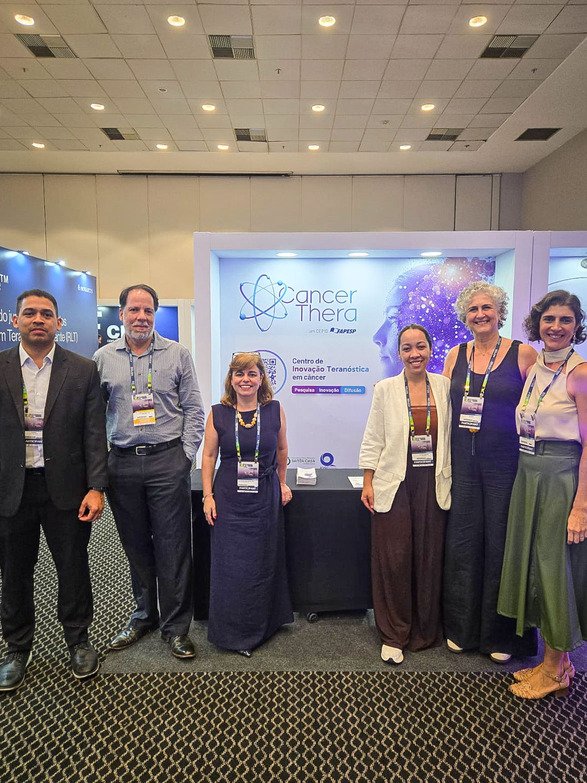
With the aim of strengthening relationships with the global scientific community and the market, CancerThera had an exclusive booth for visitation. Responsible for production and reception at the space, Dr. Maria Elvira Pizzigatti Correa, dentist and postdoctoral researcher in Executive Research Management linked to the center, provided an overview of interactions throughout the days of the congress.
“We had excellent receptivity from everyone. We established many valuable contacts with companies and researchers, both nationally and internationally,” reports Correa. The researcher noted that the audience of the event, which included many foreign professionals, was reflected in the booth traffic. “There was genuine interest in learning about the research developed by CancerThera, which shows the value of our work in an environment focused on scientific exchange with world-renowned leaders,” she says.



Academic production and scientific evaluation
In the scientific axis, there was also participation in essential debates at the event. Dr. Luciana Malavolta Quaglio, radiochemist, professor at the Faculty of Medical Sciences of Santa Casa de São Paulo and principal investigator at CancerThera, highlighted the high level of internationalization of the symposium, noting that “half of the participants were foreigners.” She emphasized that participants brought advances and innovations in preclinical studies, translational applications and clinical practices to the debate, as well as addressing dosimetry, quality assurance and radiopharmaceutical production using alpha-emitting radionuclides.
Malavolta, who presented two works focused on the use of apigenin (titled Apigenin: perspectives in Nuclear Medicine) and on peptide radiolabeling strategies (Radiolabeling Strategies for Peptides Targeting αvβ3 Integrin and EGFR using β-emitting Radionuclides), saw strong alignment with the research center: “There is total convergence between what was addressed at the event and CancerThera, and it was, without a doubt, an opportunity for exchange of experiences and potential collaborations.”
This practical link between the laboratory bench and the clinic was also evidenced by chemist and PhD candidate Aline Morais de Souza, who presented the ePoster of the work mentioned above on strategies for peptides targeting αVβ3 integrins and EGFR. “The discussions, in general, brought an important perspective on the challenges between laboratory research and production with clinical potential, considering regulatory requirements, reproducibility and quality control,” explained the researcher, who is advised by Malavolta and is a fellow at CancerThera. She also argued that the event consolidated the perception that “basic research needs to be aligned with clinical need/application and with the real demands of the healthcare field, which further reinforces the relevance of the work developed within the research center.”
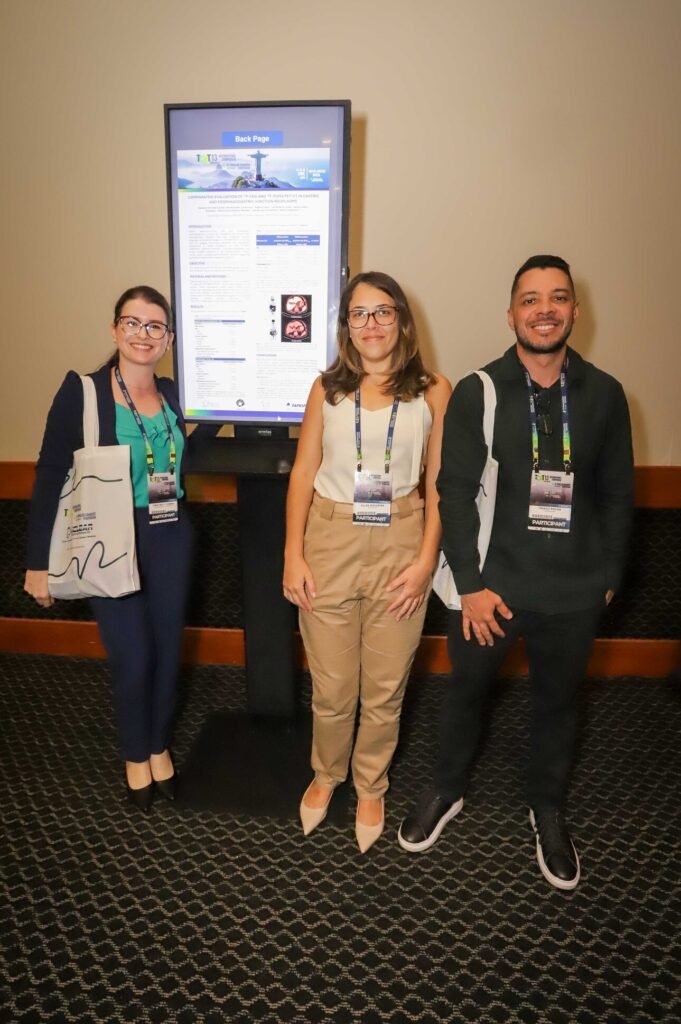
Doctoral candidates Thiago Soares Rocha Alves (Theranostic in metastatic melanoma) and Caroline Torricelli Corrêa (Comparative evaluation of 18F-FDG and 18F-PSMA PET/CT in gastric and esophagogastric junction neoplasms), as well as postdoctoral researcher Ellen Nogueira Lima (Exploring the potential of PSMA PET/CT in pleomorphic sarcomas: a comparison with FDG PET/CT), all supervised by Etchebehere, also presented their work.
In addition to disseminating research results, the team contributed to scientific validation. Dr. Celso Dario Ramos, nuclear physician, professor at FCM/Unicamp and principal investigator at CancerThera, actively served as an evaluator in the poster session, celebrating the format: “It is always very interesting to be able to talk with the authors in a more informal way, engaging closely with them,” he comments.
Following sector updates, Ramos, who is also part of the event’s organizing committee, praised the global innovations discussed, mentioning everything from the success of beta therapy in prostate cancer – led by pioneers such as Dr. Michael Hofman, nuclear physician and director of the Peter MacCallum Cancer Centre in Australia – to the new frontiers of alpha therapy. “What caught my attention was the treatment of brain tumors with alpha emitters. Currently, there are some studies proposing the intratumoral injection of these emitters, with some promising results,” he highlights.
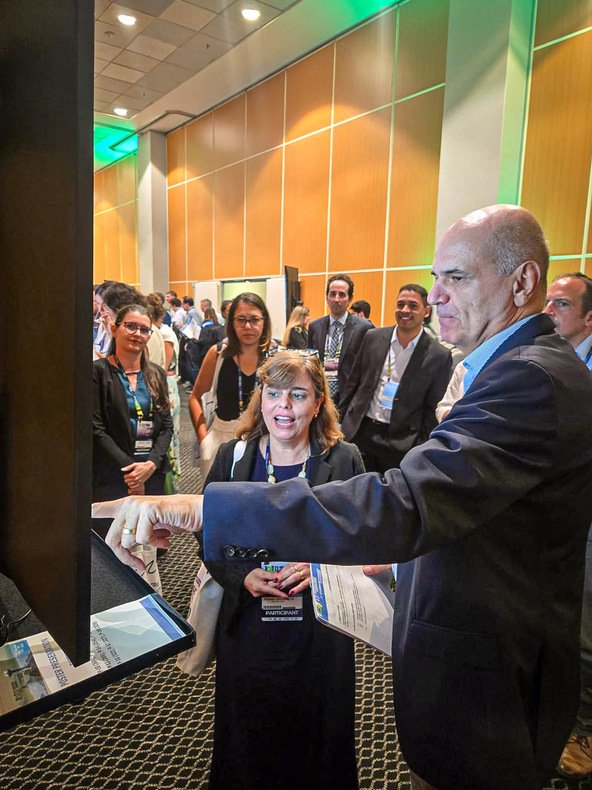

More photos from the event can be accessed at this link.
Text: Romulo Santana Osthues | Photos: Rodrigo Augusto (offered by SBMN) and Maria Elvira Pizzigatti Correa (CancerThera)