





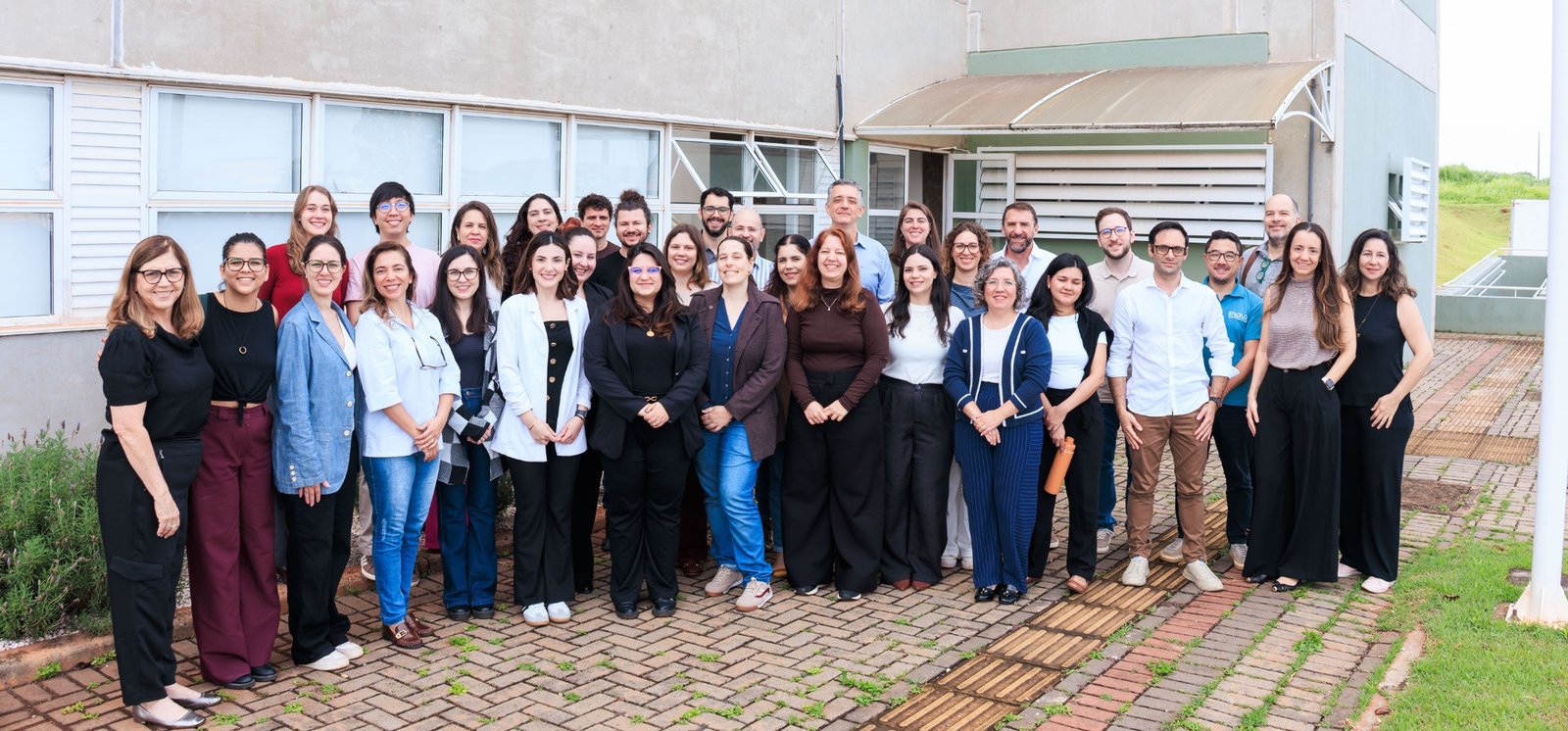
Members of CEPID CancerThera concluded their participation in the edition of the workshop “From the bench to the market”, an initiative promoted by the Innovation Agency of the State University of Campinas (Inova/Unicamp) in partnership with the Venture Builder Gridx Brazil. Held from August 25th to October 14th, the program was part of face-to-face meetings and individual mentorships aimed at bringing academic production closer to the environment of the entrepreneurial ecosystem.
The center team was made up of Maria Carolina Santos Mendes, associate researcher and postdoctoral student in innovation management and technology transfer, Leonardo Pissinato, post-doctorate and Renata Erbert Contriciani, PhD student, supervised by the Dr. José Barreto Campello Carvalheira, professor at the Faculty of Medical Sciences at Unicamp and lead researcher at CEPID CancerThera.
Throughout the activities, distributed among five face-to-face meetings and mentoring sessions, the researchers dedicated themselves to the application in the market of a software developed by CancerThera researchers, which served as the basis for the structuring of a platform aimed at evaluating predictive biomarkers in images, designed to analyze complex image patterns associated with therapeutic responses and support clinical decision-making.
For Maria Carolina Santos Mendes, the experience represented a unique opportunity for the connection between science and practical application. “Participating in this training was an excellent opportunity to expand the understanding of the market perspective and better understand which questions, challenges and uncertainties need to be considered from the initial stages of scientific research, aiming to transform the knowledge generated in the academy into solutions that effectively reach the market”, she highlights. Mendes also mentions that one of the main learnings was to realize the relevance of dimensioning factors such as demand, competitive differentials, intellectual property and scalability right at the beginning of the process.
The workshop also highlighted the difficulties of crossing the cultural barrier between scientific research and the productive sector. For the post-doctorate Leonardo Pissinato, participation was decisive in understanding that the transfer of knowledge from the academic world to the market is difficult and that both often have very different needs. “The initiative of Inova helped us to see ways to connect our production with external demands, in addition to anticipating possible limitations in the implementation of our solution as a product and ways to circumvent these restrictions”, he details.
The change in perspective experienced throughout the program also marked the experience of doctoral student Renata Erbert Contriciani. As she reports, the researchers experienced a methodological turnaround in the design of the project: “Instead of asking what our technology can do, we started to ask what problem it solves in clinical practice”. Contriciani also highlighted the importance of listening to those who have been in the market from the beginning, emphasizing that “well done scientific research is what provides the basis for a technology to actually reach the patient.”
From an institutional and strategic point of view, the group’s supervisor, Dr. José Barreto Campello Carvalheira, contextualizes the role of initiatives such as this in the face of the obstacles to technological development in health. Carvalheira points out that the great challenge is to cross the so-called “death valley” of innovation — the gap between a promising laboratory result and the realization of a viable solution for society — a crossing that requires resilience, confidence in the potential of research, rigorous validation and willingness to review paths in the light of evidence. “It also depends on funding, institutional support and partnerships that make it possible to continue the development”, he ponders.
In this sense, as the professor evaluates, participation in training programs expands the dialogue with companies and service networks, in addition to opening new perspectives for training for the students involved. “Health entrepreneurship is the ability to transform good questions and scientific results into useful solutions, maintaining the rigor of research and concern for access, including in the SUS”, he concludes.
Text: Xenya bucchioni