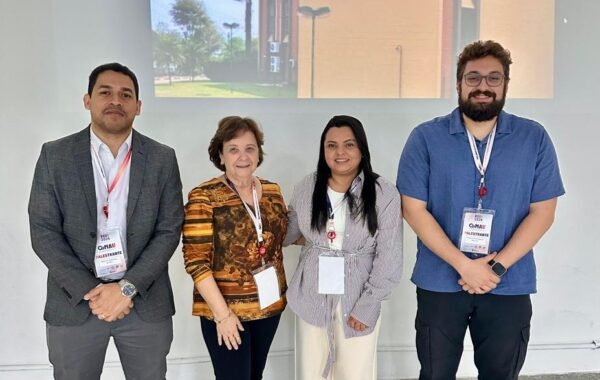





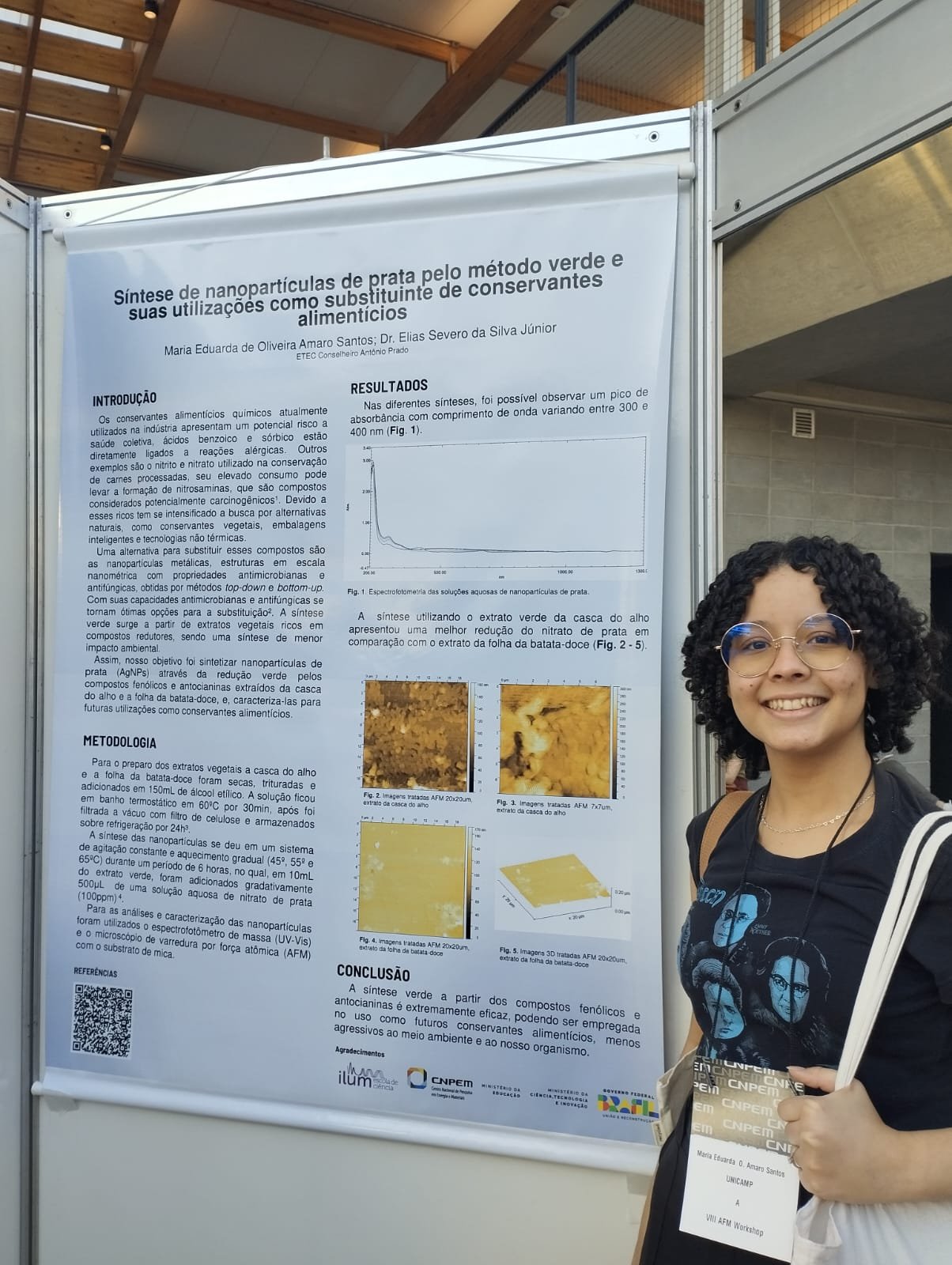

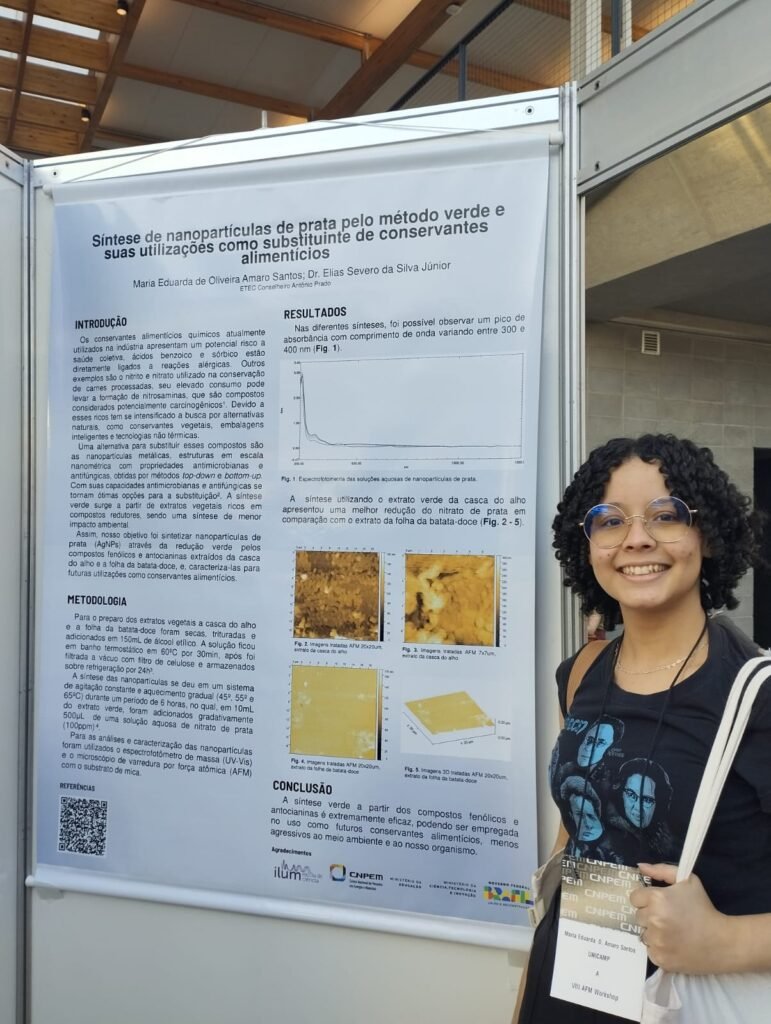
On September 17, Maria Eduarda de Oliveira Amaro Santos (photo alongside), a laboratory technician affiliated with CEPID CancerThera, presented her Undergraduate Thesis (TCC) at the 8th AFM Workshop, an event held by the Brazilian Center for Research in Energy and Materials (CNPEM).
Aiming to provide an introduction to scanning probe microscopy techniques, their different applications, as well as the state of the art in this field, the themes and presentations of the event were organized by professionals from the Atomic Force Microscopy Laboratory (MFA), the Brazilian Nanotechnology National Laboratory (LNNano), and other researchers and technicians from CNPEM, as well as invited participants.
The research that resulted in Santos’ thesis was developed in collaboration with CNPEM, reflecting not only her academic trajectory but also the importance of integration between institutions for the training of new scientific talents, enhancing practical learning, innovation, and impactful research for society.
For her supervisor, Dr. Carmen Silvia Passos de Lima, a medical oncologist and hematologist and principal investigator at CancerThera, this interinstitutional cooperation plays a strategic role. “CancerThera contributes substantially to the training of young researchers. In Santos’ case, she has been acquiring knowledge in laboratory techniques in cell culture and molecular methods, with good research practices, at the Cancer Genetics Laboratory [Lageca], where she is based,” Lima highlights.
Currently, at Lageca, a laboratory at the School of Medical Sciences of the University of Campinas, Santos collaborates on projects that evaluate new metalloradiopharmaceuticals for diagnostic and therapeutic applications in Oncology. She performs DNA and RNA extractions, cDNA synthesis, gene expression analysis, genotyping, and other related experiments.
A lasting relationship with prospects for the future
Santos’ relationship with CNPEM began during high school, when she participated in the Futuras Cientistas program, conducted by Ilum – School of Science. It was there that she first came into contact with nanotechnology and experienced an advanced research environment. “The experience I had there was very fruitful; I got to know nanotechnology, had access to several pieces of equipment, and made many friendships. From that, I was motivated to carry out my thesis,” she recalls.
Her thesis explored the “green synthesis” of nanoparticles from by-products of the food industry, such as garlic peel and sweet potato leaves, which are rich in bioactive compounds with antimicrobial potential. “The chemical synthesis of nanoparticles is harmful to our organism. So, the idea of green synthesis emerged, through which I reused these by-products to synthesize nanoparticles in a way that is not harmful to the organism and less aggressive to the environment,” she explains.
The results were promising. The nanoparticles showed a size of 10 to 15 nanometers and a spherical shape, characteristics that increase the contact surface and enhance the antimicrobial effect. “The smaller and more spherical they are, the greater their contact surface, and therefore, the better their performance,” Santos emphasizes.
Although it was conceived in the context of food preservation, the study opens doors to broader applications, including in the field of health. “At CancerThera itself, some research already works with nanoparticles to encapsulate compounds and make them more effective carriers for target cells. The nanoparticle synthesized by the green method could indeed be applied under these conditions, bringing advantages such as not being toxic or reactive,” the researcher projects.
Text: Romulo Santana Osthues | Photos: Researcher’s personal archive