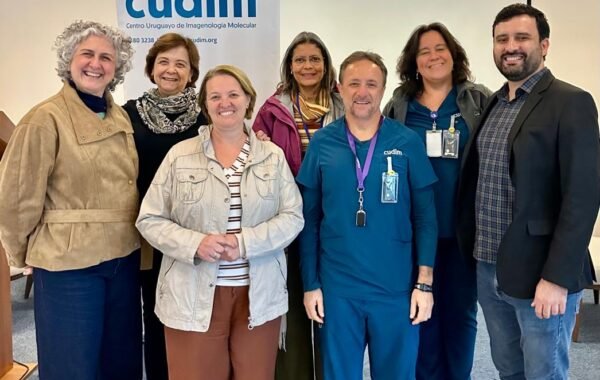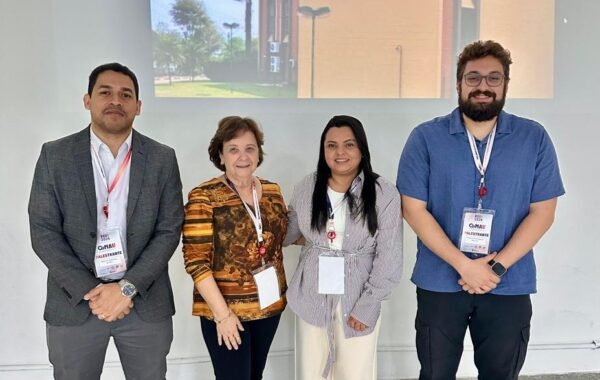





The Innovation Agency of the University of Campinas (Inova Unicamp) held, on October 21, the workshop “Prior art search in patent databases,” aimed at the CEPID CancerThera community and other interested parties. Held at the Graduate Amphitheater of the School of Medical Sciences (FCM) at Unicamp, the activity brought together more than 30 participants—among students, faculty, and researchers—with the goal of strengthening the culture of innovation and disseminating knowledge about intellectual property and the strategic use of patent databases.
Led by Inova Unicamp’s intellectual property analysts, Dr. Bread Leandro Gomes da Cruz and Ms. Isabela Lima Braz Guedes, the workshop was structured in two stages: a conceptual part, focused on understanding the fundamentals of intellectual property, and a practical part, dedicated to the use of tools such as Orbit, Lens, Google Patents, and the database of the National Institute of Industrial Property.

Prior art search as a strategy
During the introduction, the instructors explained what a patent is and other forms of protection for an invention, such as computer programs, plant varieties, industrial designs, and know-how, highlighting what can and cannot be protected.
“Prior art search is an indispensable strategic tool to drive innovation and the practical applicability of CancerThera’s research,” emphasizes Cruz, who is a biologist and has worked at the Nutrition and Cancer Laboratory of the Institute of Biology at Unicamp. “By mapping the state of the art and existing solutions, the CancerThera team can precisely identify where current knowledge is limited or where problems remain unsolved. This directs research toward areas of real innovation, avoiding duplication of efforts and resources,” he adds.
“Inova Unicamp professionals contribute to the training of our researchers so that they have innovation as a focus in the development of projects and products, and this is a highly desirable perspective—although uncommon among university researchers,” notes Dr. Carmen Silvia Passos Lima, a hematologist and oncologist, professor at FCM/Unicamp, principal investigator, and coordinator of the Innovation area at CancerThera.
She also mentions the Agency’s fundamental role in patent filing for the development of high-innovation-potential products being conducted at the center, as well as the transfer of these technologies to the market, connecting CancerThera researchers with industry professionals for potential contracts.
“The holding of this day of interaction between researchers from our center and professionals from Inova Unicamp, aimed at training in prior art search for patent filing, is a good example of the activities that the Agency promotes within the scope of our partnership,” says Lima.
Dr. Maria Carolina dos Santos Mendes, a nutritionist and postdoctoral researcher in Research Management – Innovation at CancerThera, highlighted the relevance of the topic for the center’s members: “I believe that acquiring knowledge about the different forms of intellectual property protection and learning how to carry out prior art searches related to the topics of their research is a great differentiator for us to develop increasingly innovative projects,” she says.
She also reinforces the importance of understanding the limits of what is patentable: “Research results often lose the possibility of patent protection because they do not meet the novelty requirement. This occurs, in many cases, due to lack of information, when the researcher themselves discloses their results in advance at conferences, scientific publications, dissertations, or theses, which makes future patenting unfeasible.”


An indispensable workshop
The workshop was also seen as an opportunity to enhance the strategic perspective of CancerThera researchers regarding innovation, across different academic levels and in the various laboratories in which they work.
Dr. Juliana Carron, for example, a biomedical scientist and postdoctoral researcher at CancerThera, affiliated with the Cancer Genetics Laboratory at FCM/Unicamp, states that participating in the course was enriching. “It was possible to better understand how this process can directly contribute to increasing the innovative potential of academic research. This more critical and well-founded perspective is essential to generate truly original results with greater potential for practical application,” says Carron.
For Fabíola Furtuoso Zarpelão, a medical oncologist and master’s student at CancerThera, affiliated with the Molecular Oncology Laboratory at FCM/Unicamp, the activity allowed her to delve deeper into the context in which her research project is situated: “I considered it important to learn how to understand the scenario in which my project is inserted, as well as to see what other groups are studying around the world and ways to patent our projects. I really enjoyed participating.”
“I imagine that practice leads to perfection. So, the sooner we make this a habit, the better it will be for research and future projects. Certainly, one of the best and most enlightening workshops I have ever attended,” evaluates Francisco Mastrobuono C. de Almeida, a master’s student at CancerThera, affiliated with the Bioinorganic and Medicinal Chemistry Laboratory at the Institute of Chemistry at Unicamp. He highlighted the practical part of the workshop as a differentiator: “The patent search strategy using advanced search, allowing the application of various filters—such as date, patent status, universal codes, and keywords—was very interesting. And, especially, the analysis of these data, with the generation of graphs, schemes, and statistics that can be exported for presentations and meetings.”
The initiative reinforces CEPID CancerThera’s commitment to innovation and technology transfer, particularly regarding its main objective, which is to develop new metallodrugs and metalloradiopharmaceuticals for use in the care of oncology patients. For the center, understanding the global patent landscape is essential not only to protect scientific discoveries, but also to ensure that these products and other related solutions have real effectiveness.
As Bread Cruz emphasizes, “prior art search is an important step in the innovation cycle and, for CancerThera, it acts as a guide for the development of metallodrugs and metalloradiopharmaceuticals with clear competitive advantages and a high potential to positively impact cancer diagnosis and treatment.”
Text and photos: Romulo Santana Osthues