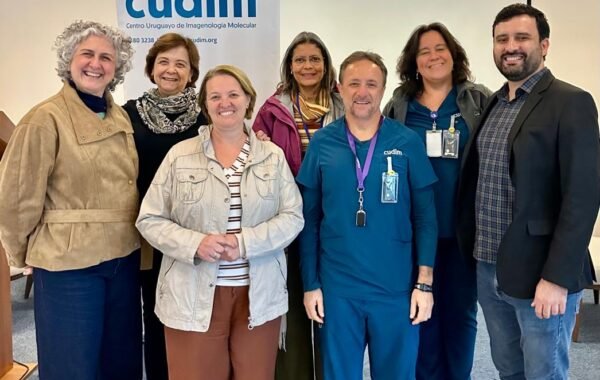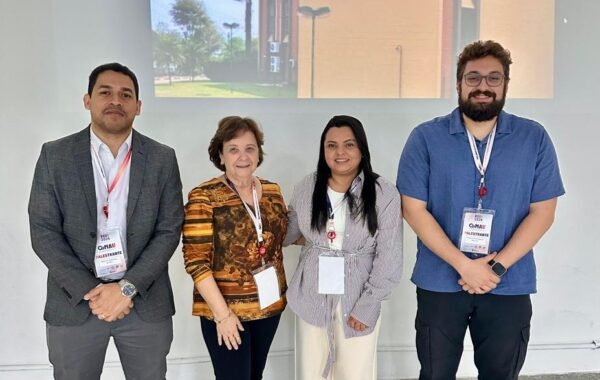





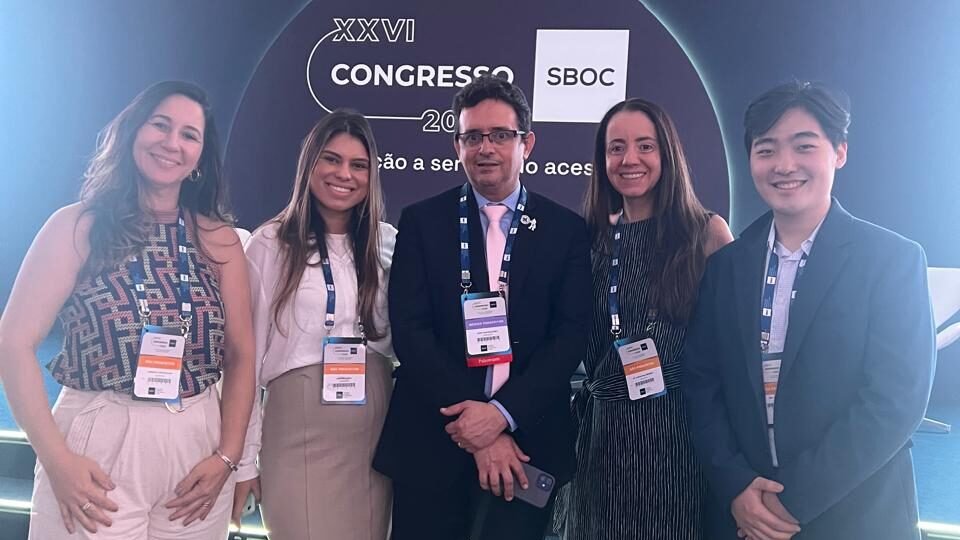

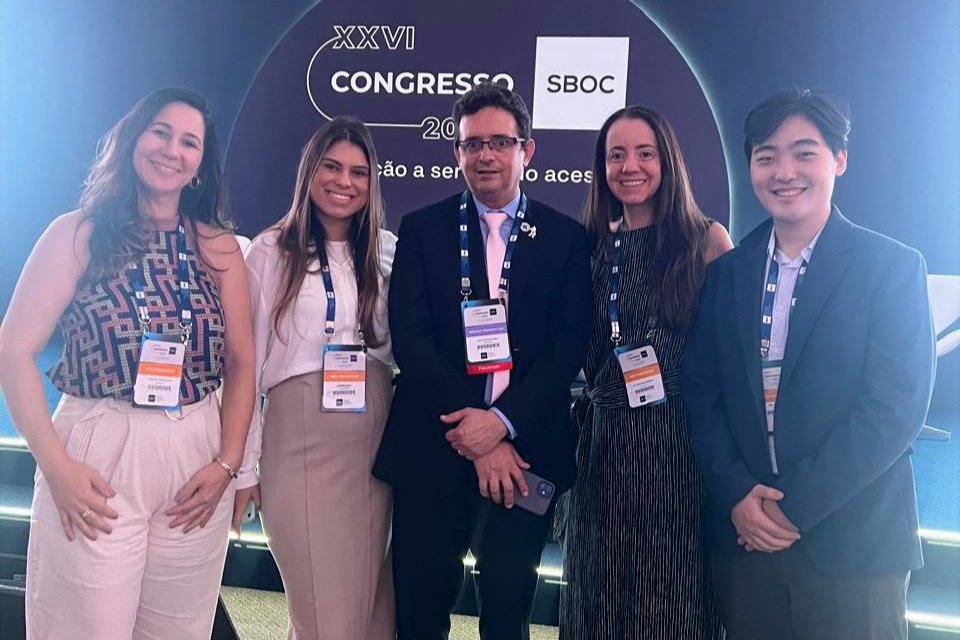
Between November 6 and 8, the city of Rio de Janeiro hosted leaders, experts, and some of the most prominent national and international figures in Oncology for the 26th Brazilian Congress of Clinical Oncology, organized by the Brazilian Society of Clinical Oncology (SBOC). Under the theme “Innovation in the Service of Access,” the event reinforced the urgency of bringing scientific advances closer to patients’ realities — a mission that directly aligns with the work carried out by CEPID CancerThera. Researchers affiliated with the center actively participated in the discussions and presented results from their most recent studies.
Dr. Lígia Traldi Macedo, an oncologist at the Hospital de Clínicas of the University of Campinas (Unicamp) and an associated researcher at CancerThera, highlighted the evolution in the scientific quality of recent editions of the congress, reinforcing its growing relevance for professionals working in the field. According to her, the session “Innovations in the Treatment of Head and Neck Cancer” provided a comprehensive view of the Brazilian scenario, addressing topics such as care pathway organization and the early use of immunotherapy. The discussion on “overtreatment” and the need for “smart access to new technologies” was particularly striking, emphasizing that multidisciplinarity must be accompanied by rational decision-making. “It was a session focused on updates, but at the same time closely aligned with the real needs of clinical practice,” she stated.
For Dr. Maria Carolina Santos Mendes, a nutritionist, associated researcher, and postdoctoral fellow in Research Management – Innovation at CancerThera, the central theme of the congress reinforced an essential message: “innovation is only complete when it actually reaches the population.” She also emphasized the importance of producing science aligned with Brazilian needs and the access challenges faced by patients. In this context, the work of CancerThera — focused on developing accessible diagnostic and therapeutic strategies — becomes even more relevant. “The discussions experienced at the congress gave me confidence that our research is aligned with the current innovation agenda in health,” she said.
Learnings in innovation, care, and scientific training
Dr. Renata Erbert Contriciani, a biologist and PhD researcher at the Molecular Oncology Laboratory of the School of Medical Sciences (FCM) at Unicamp, linked to CancerThera, highlighted the opening of the congress as a symbolic moment: the signing of new ordinances by the Brazilian Ministry of Health expanding access to CDK inhibitors for advanced breast cancer and to hepatic metastasis ablation procedures. For her, these measures represent concrete advances for oncology patients.
She also emphasized sessions on oncogenomics and workshops on clinical studies, which addressed topics such as artificial intelligence in drug development, diagnostic models, and the evolution of clinical trial designs. In particular, she highlighted the lecture by Dr. Glenn Hanna, an oncologist at the Dana-Farber Cancer Institute, on liquid biopsy. “It was an honor to participate in the SBOC 2025 Congress. It is an example of how it is possible to integrate clinical practice and clinical research in a single event for physicians and multidisciplinary teams,” she said.
Larissa Ariel Oliveira Carrilho, MSc, an oncology nutritionist and PhD candidate linked to the same laboratory, described her participation as an important milestone in her academic trajectory, especially given her work in Oncology. Discussions on the growing diagnosis of cancer in young adults — a trend also observed in her studies — as well as debates on genomics and the impact of physical activity on patient survival, stood out. “As our laboratory is multidisciplinary, it was very interesting to see the relationship between physical exercise and cancer,” she emphasized.
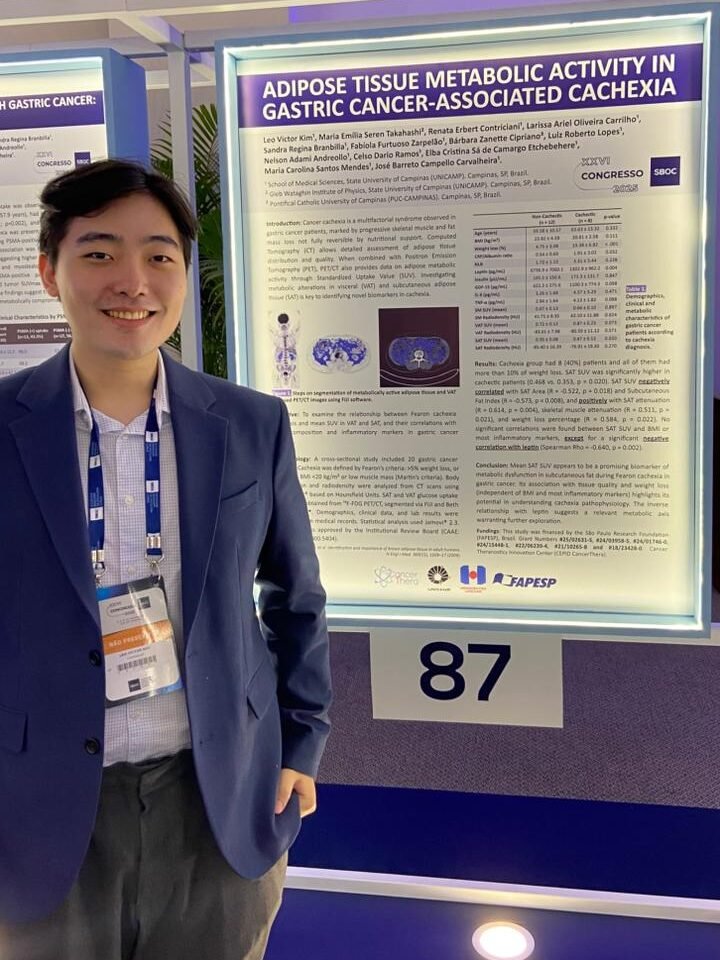
For medical student and undergraduate research fellow Leo Victor Kim, the congress reinforced the intersection between theory, research, and clinical practice in contemporary Oncology. He highlighted discussions on data science, liquid biopsy, oncogenetics, and the advancement of digital technologies. For Kim, a laboratory colleague of Carrilho and Contriciani, one of the most memorable moments was the Happy Poster session, which enabled direct exchanges with researchers from different institutions. “I left the congress motivated by the contact with innovative professionals and by the desire to continue evolving and contributing to science in the Brazilian context,” he reported.
Presented studies
Supervised by Dr. José Barreto Campello Carvalheira, professor at FCM/Unicamp and principal investigator at CancerThera, and co-supervised by Maria Carolina Santos Mendes, the following studies were presented at the SBOC 2025 Congress, with primary authorship by Contriciani, Carrilho, and Kim:
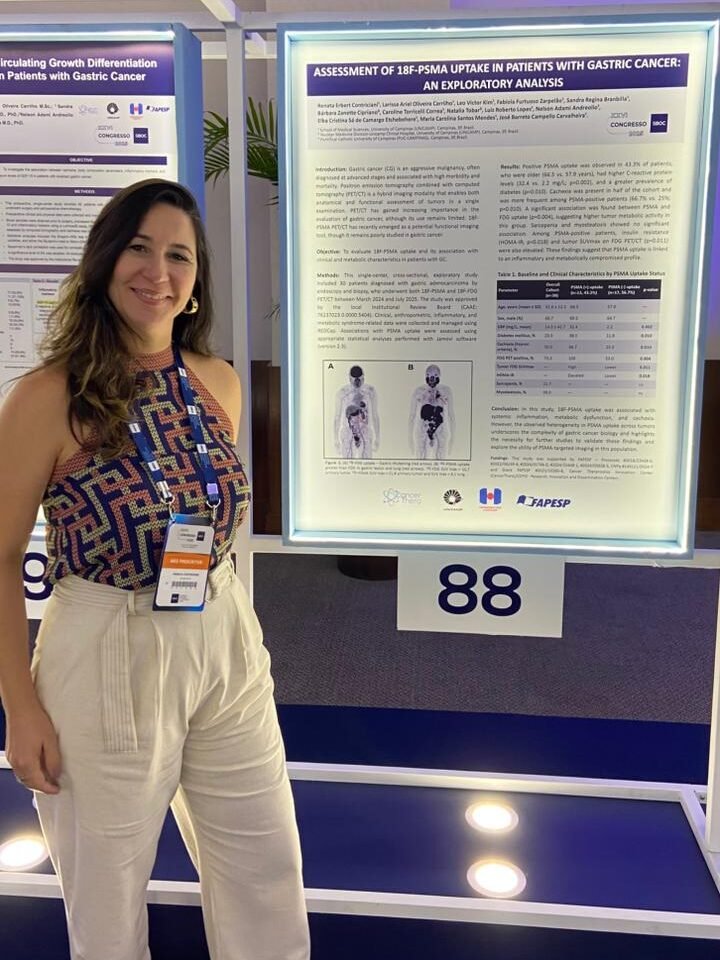
1. “Assessment of 18F-PSMA Uptake in Patients with Gastric Cancer: An Exploratory Analysis”
Authors: Renata Erbert Contriciani, Larissa Ariel Oliveira Carrilho, Leo Victor Kim, Fabíola Furtuoso Zarpelão, Sandra Regina Branbilla, Bárbara Zanette Cipriano, Caroline Torricelli Correa, Natalia Tobar, Luiz Roberto Lopes, Nelson Adami Andreollo, Maria Carolina Santos Mendes, Elba Cristina Sá de Camargo Etchebehere, José Barreto Campello Carvalheira.
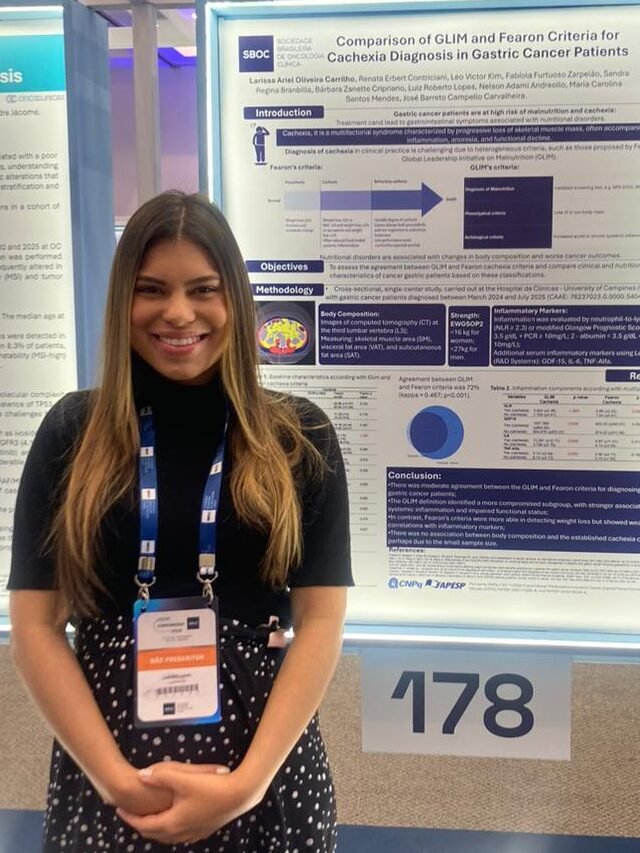
2. “Comparison of GLIM and Fearon Criteria for Cachexia Diagnosis in Gastric Cancer Patients”
Authors: Larissa Ariel Oliveira Carrilho, Renata Erbert Contriciani, Leo Victor Kim, Fabíola Furtuoso Zarpelão, Sandra Regina Branbilla, Bárbara Zanette Cripriano, Luiz Roberto Lopes, Nelson Adami Andreollo, Maria Carolina Santos Mendes, José Barreto Campello Carvalheira.
3. “Adipose Tissue Metabolic Activity in Gastric Cancer-Associated Cachexia”
Authors: Leo Victor Kim, Maria Emília Seren Takahashi, Renata Erbert Contriciani, Larissa Ariel Oliveira Carrilho, Sandra Regina Branbilla, Fabíola Furtuoso Zarpelão, Bárbara Zanette Cipriano, Luiz Roberto Lopes, Nelson Adami Andreollo, Celso Dario Ramos, Elba Cristina Sá de Camargo Etchebehere, Maria Carolina Santos Mendes, José Barreto Campello Carvalheira.
Text: Romulo Santana Osthues | Photos: Researchers’ personal archives