



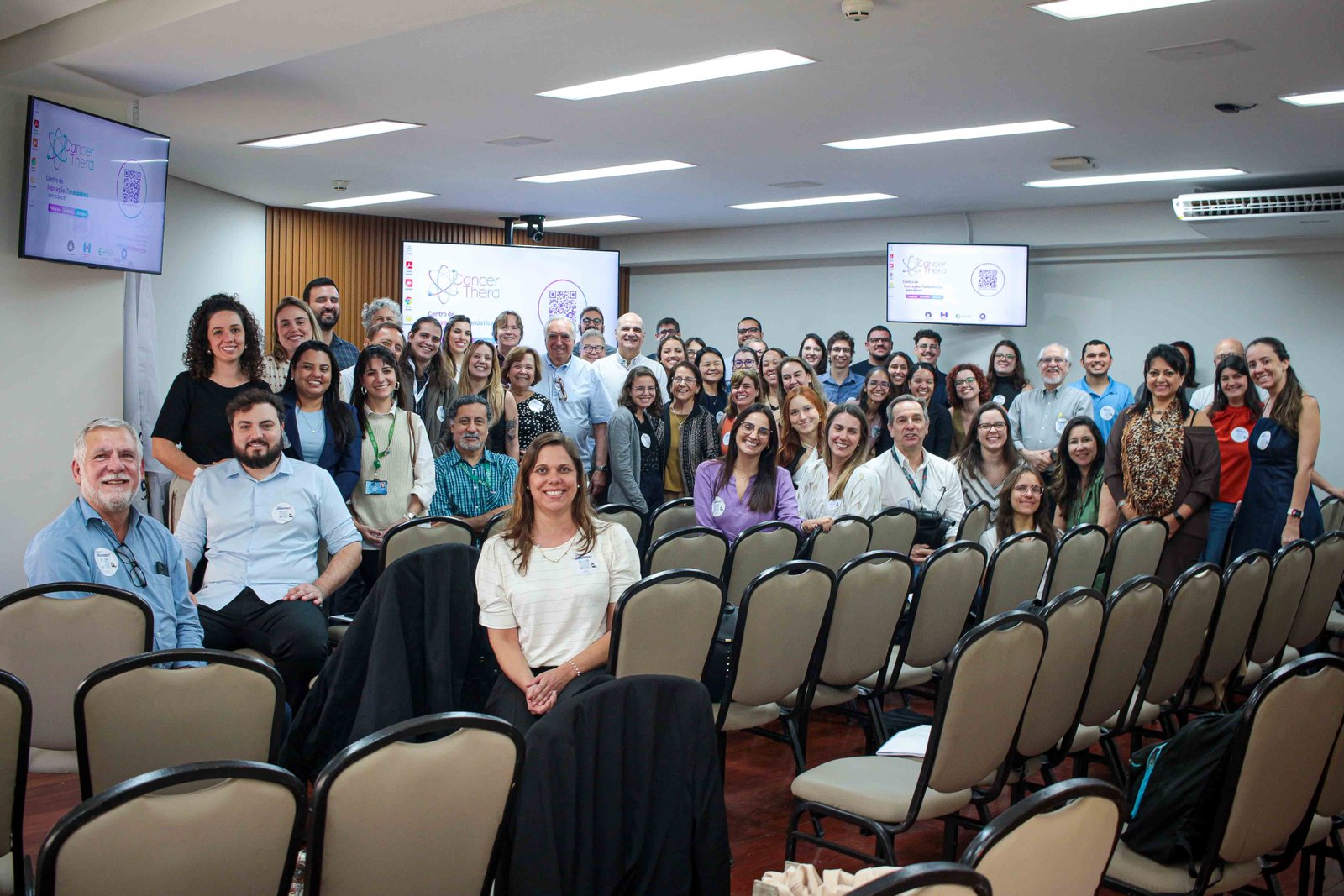

On November 28, the RIDC CancerThera held the second edition of its annual workshop—an event dedicated to the teams that make up the research center, marked by the celebration of interdisciplinarity and by concrete advances in investigations aimed at innovating cancer diagnosis and treatment in Brazil.
The event brought together principal investigators, associate researchers, students, and collaborators for an intense day of scientific exchange, reaffirming the center’s commitment to high-quality translational research—integrating basic, preclinical, and clinical studies—to develop radiopharmaceuticals and metallodrugs for use within the Theranostic model.
CancerThera has stood out for the speed with which it articulates different fields of knowledge. For Dr. Carmino Antonio de Souza—onco-hematologist, professor at the School of Medical Sciences of the University of Campinas (Unicamp), and principal investigator at CancerThera—the event reflected the group’s growing maturity. “It was a success. We see the number of people working, producing science, producing intersectoriality, producing projects… With that, we can be sure that the CancerThera CEPID is progressing in an extremely virtuous way,” he says.
According to Souza, the volume of academic production and innovation is remarkable for the center’s lifetime—this month marks two and a half years since its approval by the São Paulo Research Foundation (FAPESP), its main supporter. “We see an immense number of projects, papers already in progress, ongoing projects, new projects to come, innovation and patents. It is incredible how the center has grown in such a short period,” he adds.


From bench to bedside: integration and innovation in translational research
“It was truly a moment for people to interact as much as possible. I hope we have many more opportunities for meetings like this, involving science, technology, and development, and to get to know even better the people who are part of our project,” says Dr. Pedro Paulo Corbi, chemist, professor at the Institute of Chemistry at Unicamp, and principal investigator at CancerThera.
The presence of researchers from outside the university and from international institutions, he notes, reinforces the center’s growth this past year. “The event was sensational, very well organized, a highly productive day with works from all areas. Many results, much innovation,” he says enthusiastically.
This connection among teams is also highlighted by Dr. Maria Elvira Pizzigatti Corrêa, dental surgeon and postdoctoral fellow in Research Management at CancerThera. To her, the workshop fulfilled the vital role of aligning internal knowledge. “It’s important for us to create this translation—that is, to create dialogue among teams, for teams to know what others are doing, to understand the topics, help each other, and work together. That was one of the most beautiful things that happened at this event,” she celebrates.
Another major highlight of the workshop was the ability to integrate basic science with clinical application, bridging through preclinical studies. Dr. Fábio Luiz Navarro Marques—chemist, researcher at the University of São Paulo (USP) School of Medicine, and CancerThera associate—emphasizes this unique characteristic, which brought together researchers from various fields, each focused on a different stage of the translational research chain.
The event featured 43 presentations, covering the full spectrum of radiopharmaceutical and metallodrug development for theranostic applications. According to Marques, this showcase points to a promising future of real-world contributions to society. “We were able to see everything CancerThera is producing and will deliver to society soon—months and years from now. And who knows, by the end of the project, with the high-quality science we are doing today, we may have developed products that will benefit the Brazilian population in the diagnosis and therapy of cancer,” he stresses.

International recognition and synergy in the scientific program
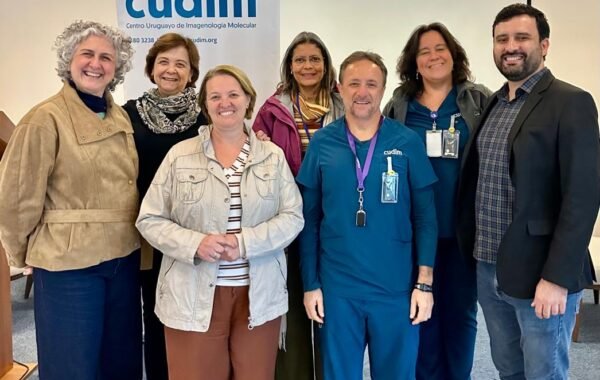
The quality of the research presented impressed Dr. Eduardo Osvaldo Savio Quevedo, radiopharmaceutical scientist, technical director of Radiopharmacy and associate professor at the Uruguayan Center for Molecular Imaging (CUDIM). A member of CancerThera’s international advisory board, he emphasized the challenge the group successfully addressed in bringing together so many distinct fronts—articulating multiple research groups spanning Hematology, Oncology (preclinical and clinical), Nuclear Medicine, Radiopharmacy, and Radiochemistry.
Before attending the event, he says he was curious to see how far researchers had advanced in “articulating perspectives that are very different from one another to work synergistically, strengthen knowledge, and introduce innovative ideas.”
Having seen the practical results in the abstract book and dynamic presentations, Savio was generous in his praise: “When I received the abstract book and found nearly 50 works covering this full range of thematic areas, I was first impressed. And afterward, witnessing here—respecting the time—the challenge of speaking in five minutes, and still being able to present the progress of each work with enthusiasm and commitment, and to put ideas on the table and open them up for discussion.”
He projects a broader impact: “I believe this will be—and already is—an innovative project in Brazil, and in the medium term we will see its impact not only in São Paulo state but throughout Brazil. And we will also see how we can better connect with South America to lead innovation in the field of Theranostics.”
The 2nd CancerThera Workshop program was structured to cover all stages of the innovation chain in the theranostic model and in research project management. Starting with a keynote lecture by Eduardo Osvaldo Savio Quevedo on preclinical development, the day continued with four robust thematic blocks.
The first block focused on clinical PET/CT applications and oncologic diagnostics, addressing topics from multiple myeloma to lung cancer. The second block explored the development of metallodrugs, including gold-, silver-, and copper-based complexes with antitumor potential. After lunch, the discussions in blocks 3 and 4 centered on the optimization of radiopharmaceuticals and the development of chelators—including studies using gallium and lutetium—as well as tumor metabolism and radiomics.
A final section addressed research management, illustrating the complexity and breadth of the center’s investigations in administration, innovation, education, and knowledge dissemination.


Toward the 3rd CancerThera Congress
The success of the 2nd CancerThera Workshop served as strategic preparation for the 3rd CancerThera Congress, scheduled for March 12–13, 2026. The upcoming event promises a broader program, again focused on translational research in theranostics, and will include a pre-congress course on training in Radiochemistry and Inorganic Chemistry applied to the development of diagnostic and therapeutic radiopharmaceuticals.
“We will cover everything from the basics—radioactive decay—to the fundamentals of Inorganic Chemistry, and how these two come together to create theranostic radiopharmaceuticals,” explains Fábio Luiz Navarro Marques, who will teach the course alongside Dr. Victor Marcelo Deflon, chemist, professor at the Institute of Chemistry of São Carlos (USP), and CancerThera principal investigator. Registration for the congress will open soon.
Text: Romulo Santana Osthues | Photos: Romulo Santana Osthues, Adrhyann Portilho, Aline Morais de Souza, Carmen Silvia Passos Lima, Caroline Torricelli, Daniele Affonso, Gabrielle Menezes, Giulia Bordoni, Natália Tobar, and Patricia Frascarelli.