





A research developed at the Center for Therapeutic Innovation in Cancer (Cancerthera), linked to the Research, Innovation and Diffusion Centers Program (CEPID) of the São Paulo Research Support Foundation (FAPESP), investigates the antitumor potential of citrus pectin modified (MCP) and galectin-3 (Gal3). The study uses animal models, radiopharmaceuticals and molecular imaging techniques to evaluate possible applications of these molecules in the diagnosis and treatment of cancer.
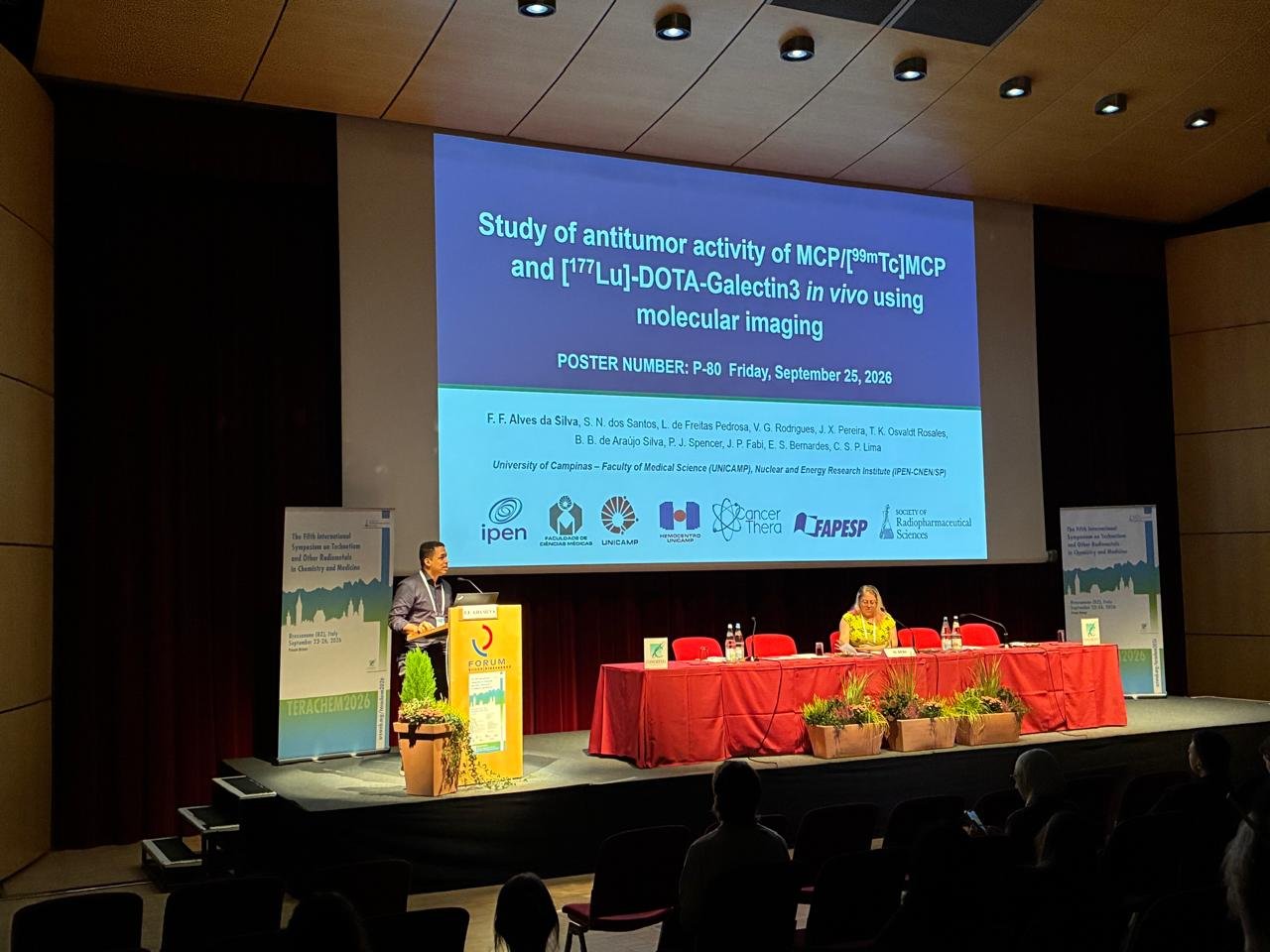
Entitled study of antitumor activity of mcp and[¹⁷⁷Lu]-Dota-Gal3 in vivo using molecular imaging, The work was developed at the Laboratory of Cancer Genetics at FCM/UNICAMP, under the supervision of Prof. Dr. Carmen Silvia Passos Lima, in collaboration with the Institute for Energy and Nuclear Research (Ipen). The results were presented by researcher Fábio Fernando Alves da Silva at Terachem 2026 – International Symposium on Technetium and Other Radiometals in Chemistry and Medicine, held from September 23 to 26, in Bressanone, in Italy.
The research evaluated two molecules: the MCP radiolabeled with technetium-99m ([⁹⁹ᵐTc]]TC-MCP), a polysaccharide with antitumor properties, and the galectin-3 conjugated to the chelating agent endorsed and radiolabeled with lutetium-177 ([177Lu]lu-dota-gal3), protein involved in tumor environment processes.
RESULTS OF PRE-CLINICAL STUDIES
In animal models with ovarian tumors (SKOV-3) and stomach (MKN45), intravenous MCP administration reduced tumor growth in the SKOV-3 model by approximately 50%. In the molecular imaging (Microspect/CT) MCP radiolabeled MCP reached the tumor and associated with regions of cell death. The absence of galectin-3 was also related to the faster elimination of the molecule.
The compound[177Lu]Lu-dota-Gal3 showed radiochemical purity of 97.33 ± 2.36%, stability greater than 95% in saline solution for up to 72 hours and preservation of the biological functionality of galectin-3. In animal models with GL261 tumors, the treatment reduced tumor growth.
The findings indicate the potential of MCP as a radiotracer for biological and pharmacokinetic studies and galectin-3 as a carrier for therapeutic radionuclides. The results, however, are preclinical and still do not prove effectiveness in humans.
Exchange and scientific collaboration
At Terachem 2026, a symposium organized by the Society of RadioPharmaceutical Sciences (SRS), the researcher also had contact with advances in radiochemistry, new therapeutic targets, functional chelators, synthesis routes. and preclinical evaluation of radiopharmaceuticals.
“It was an opportunity to present one of the works that we conducted at CancerThera in collaboration with the Institute for Energy and Nuclear Research (IPEN), and also to deepen our knowledge in the area of radiopharmaceutical sciences, analysis of new therapeutic targets, new chelating functional, synthesis routes, and pre-clinical evaluations of new radiopharmaceuticals”, reports Silva.
The researcher also highlights the possibility of expanding scientific collaboration. “Especially, it was an opportunity to establish partnerships and collaborations with research groups that work with therapeutic applications in various diseases, using radiopharmaceuticals for diagnosis and therapy with radioligands”, he concludes.
Text: Roberta Steganha