



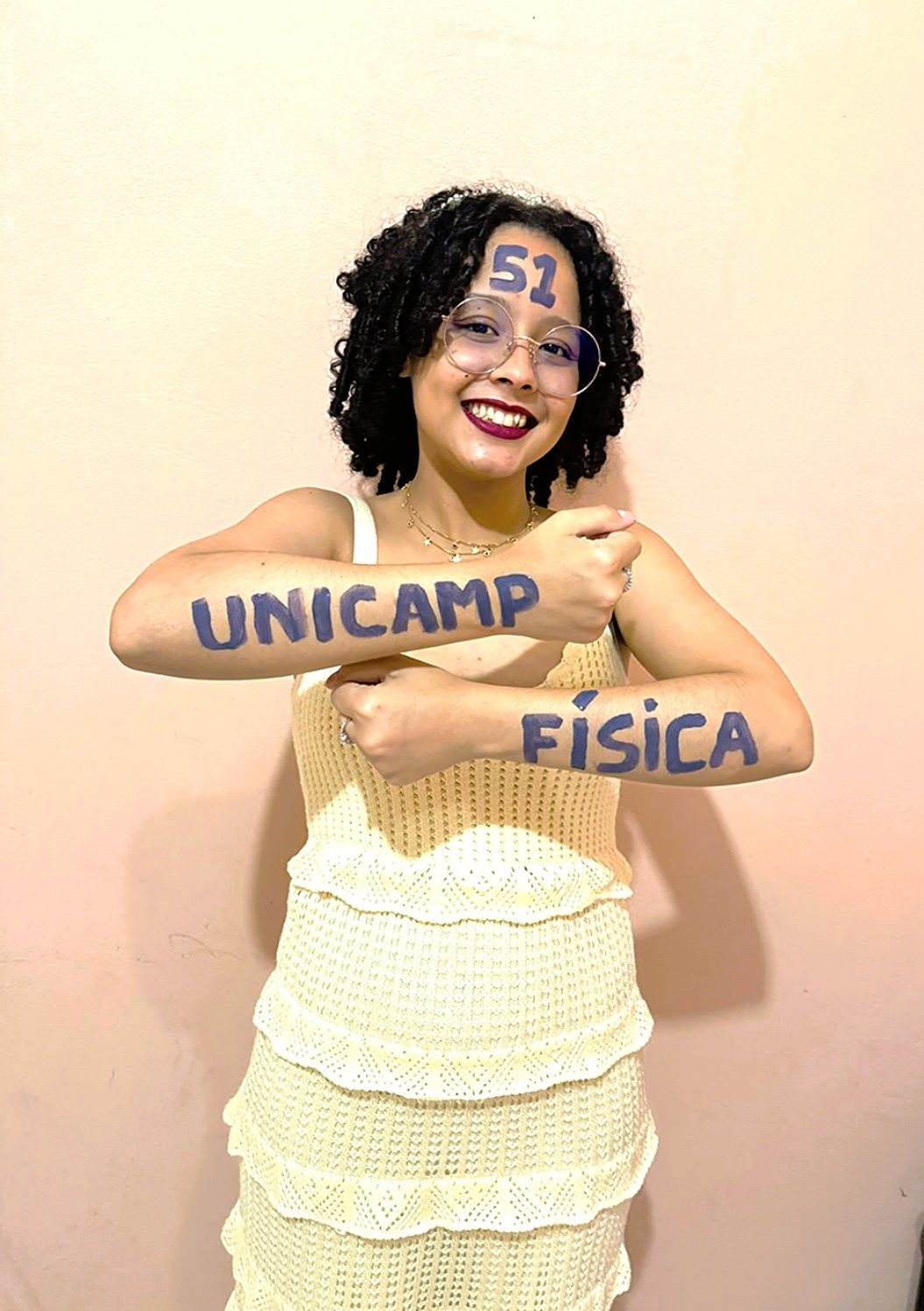

For many students, choosing a university career is a leap into the unknown. For Maria Eduarda Amaro Santos, however, the decision to pursue a degree in Physics at the Institute of Physics Gleb Wataghin of the University of Campinas (IFGW/Unicamp) was the result of a deep and transformative immersion in the world of applied science. Her recent success in the university entrance exam is not only an academic achievement; it is the newest chapter of a story that began to take shape in the laboratories of CEPID CancerThera.
Maria Eduarda, who already holds a technical degree in Biotechnology, worked as a Technical Training Level 2 (TT2) fellow, funded by the São Paulo Research Foundation (FAPESP), at the Cancer Genetics Laboratory (LAGECA) of the School of Medical Sciences at Unicamp. Under the supervision of Dr. Carmen Silvia Passos Lima — oncologist and hematologist, faculty member, and principal investigator at CancerThera — she immersed herself in a complex project involving cell lines for the evaluation of new metalloradiopharmaceuticals. It was precisely the interdisciplinary nature of this environment — an experience in a genetics and molecular biology laboratory — that shaped her perspective toward Physics.
While celebrating her admission, the student reflects on the moment. “It is the fulfillment of a dream that was built gradually, with great effort, doubts, and maturation,” says Maria Eduarda. She emphasizes that her career choice was not random: “Choosing Physics came not only from my affinity for the exact sciences, but mainly from my desire to use science as a concrete tool for transformation.” She adds: “By engaging with health research, I realized that Physics can go far beyond theory and have a direct impact on people’s lives, which was decisive for my decision.”
Maria Eduarda’s trajectory did not go unnoticed by those who followed her first steps in science. Lima does not hide her pride in the student’s development. Commenting on the fellow’s time in the laboratory, the supervisor highlights qualities that go beyond technical skill: “Interest and determination in her goals,” she defines as the student’s profile.
For Lima, a technical training fellowship is a turning point in the development of young talent. Upon hearing that Maria Eduarda would pursue an emphasis in Medical Physics in her undergraduate studies, her reaction was enthusiastic: “Proud of the student!” she exclaimed, suggesting that the laboratory experience indeed had a profound impact on the student’s present life and promising future.
Multidisciplinary science: a meeting point
It was in the daily routine of CancerThera that textbook theory gained purpose. Contact with cancer research allowed the student to see beyond the traditional boundaries of school subjects. “Working in a cancer research laboratory, focused on Molecular Biology, was essential to consolidate my interest in Medical Physics,” explains the new undergraduate.
Her experimental experience revealed that major health challenges are not solved by a single field of knowledge: “In this environment, I began to see more clearly how physical concepts connect to medical applications, especially in the development of diagnostic and treatment techniques.” This perception was strengthened through collaboration with a diverse team.
At CancerThera, science is a collective effort. Maria Eduarda emphasizes that the work taught her, in practice, that “science today is only done in an interdisciplinary way.” She describes the vibrant environment where chemists, medical physicists, physicians, biologists, and pharmacists collaborate daily. For her, it became evident that “Physics, Biology, Medicine, and other fields complement each other, and it is precisely this integration that makes it possible to develop more effective and innovative solutions for cancer treatment.”
When asked about the most decisive lesson from this journey, she is emphatic: understanding the purpose behind research. “Seeing, up close, people from different fields working together to tackle a problem as complex as cancer gave me a very strong sense of meaning,” she reveals.
This motivation fueled her through the long months of exam preparation. Today, Maria Eduarda begins her undergraduate studies with the confidence of someone who knows exactly what she is seeking. “I realized that I want to be part of this kind of science: collaborative, applied, and committed to improving people’s lives.”
Her time at CancerThera also awakened in the Physics freshman a strong social awareness of the scientist’s role. Beyond pipettes and equations, she became involved in science communication initiatives promoted by the research center — such as Unicamp Open Doors and Viva Ciência — experiences she describes as transformative in shaping how she views her responsibility as a scientist.
“Science only fully fulfills its role when it is shared, discussed, and understood by society,” she says. With the maturity of someone aware of her future responsibilities, she projects: “As a future professional, my role will not be only to produce knowledge, but also to communicate it clearly, responsibly, and accessibly.”
Text: Romulo Santana Osthues | Photo: Personal archive